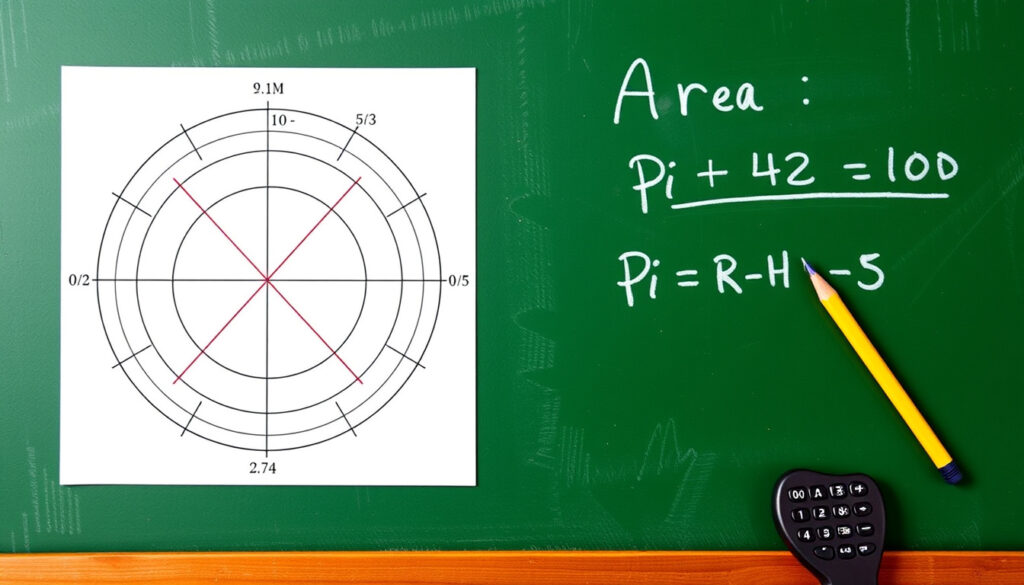
How to Find the Area of a Circle: Formula & Examples
There’s a moment in math class when a circle stops being just a shape and becomes a puzzle: how do you measure the space inside a curve with no corners? The answer has been known for over two thousand years — A = πr² — and this guide walks through how to calculate it from radius, diameter, or circumference with clear steps you can use right now.
Area formula: A = πr² ·
Pi (π) approximation: 3.14159 or 3.14 ·
Radius to diameter: d = 2r ·
Circumference formula: C = 2πr
Quick snapshot
- Area formula A = πr² is mathematically proven (BBC Bitesize (UK education authority))
- π is an irrational number with no exact decimal representation (Wikipedia (community-maintained encyclopedia))
- Exact area of a circle is always irrational because π is transcendental — no finite decimal covers it (Wikipedia (community-maintained encyclopedia))
- Formula documented since Greek geometry (~300 BCE) (Wikipedia (community-maintained encyclopedia))
- We’ll walk through radius-based, diameter-based, and circumference-based calculations with real numbers
The table below captures the essential relationships for quick reference.
| Label | Value |
|---|---|
| Standard formula | Area = π × radius² |
| Pi value | 3.1415926535… |
| Radius of a 9 cm diameter circle | 4.5 cm |
| Area of a circle with radius 4.5 cm (using 3.14) | 63.585 cm² |
How do we calculate the area of a circle?
Using the radius
The radius method is the cleanest path. Multiply the radius by itself and then by π, as the BYU-Pathway Worldwide Resource Center (university-level math resource) explains: A = π(r)². If the radius is 5 cm, the area is π × 5 × 5 = 25π ≈ 78.54 cm².
- Measure the radius — the distance from center to edge
- Square it (multiply by itself)
- Multiply by π (3.14 or the π button on your calculator)
The Third Space Learning (US math education publisher) breaks this into the same three steps: find the radius, apply A = πr², and state the answer with correct square units. Math Is Fun (popular geometry learning site) describes the result as π × radius × radius, simplified to πr².
Using the diameter
If you only have the diameter — the distance across through the center — convert it first. The Omni Calculator (math computation tool) states that diameter equals twice the radius (d = 2r), so the formula becomes A = π(d/2)². This is identical to saying A = (π/4)d², as Cuemath (geometry teaching platform) confirms.
- Divide the diameter by 2 to get the radius
- Plug the radius into A = πr²
- Or use the direct formula A = π(d/2)²
For a diameter of 12 cm, the radius is 6 cm. Area = π × 6² = 36π ≈ 113.1 cm². Using the direct diameter formula A = (π/4)(144) = 36π — same result, one fewer step if your calculator handles fractions.
Study.com (lesson-based education publisher) advises that if only the diameter is known, turn it into the radius by dividing by two first — then apply the standard formula.
A student who memorizes only A = πr² can still handle any diameter question — the radius step is a simple division. That makes the standard formula the only one you need to keep in your head.
Using the circumference
The circumference C — the distance around the circle — also gives access to area, though the path is less direct. Since C = 2πr, solving for r gives r = C/(2π). Plugging that into A = πr² yields A = C²/(4π).
- Find the circumference (measure or multiply 2π × radius)
- Square it (C × C)
- Divide by 4π
If the circumference is 31.4 cm, then C² = 985.96, and area = 985.96 / (4 × 3.14) = 985.96 / 12.56 ≈ 78.5 cm². The Calculator.net (mathematics tools platform) lists radius, diameter, circumference, and area together on one page, confirming these relationships.
The implication: all three methods — radius, diameter, circumference — collapse to the same mathematical truth because they’re linked by π.
What are the area formulas for a circle?
Standard formula
The core relationship is A = πr². The Third Space Learning (US math education publisher) states that the area of a circle with radius r is calculated with A = πr². Wikipedia (community-maintained encyclopedia) summarizes the same: the area enclosed by a circle of radius r is πr².
Pi here is approximately 3.14159, an irrational number that never terminates or repeats. For everyday use, 3.14 works; for precision work, use the π button on your calculator or go to 3.1415926535.
Formula in terms of diameter
When the diameter d is given instead of radius, A = π(d/2)². Omni Calculator (math computation tool) expresses this as A = π(d/2)², while Cuemath (geometry teaching platform) provides the equivalent form A = πd²/4. Both are algebraically identical — pick whichever fits your calculation flow.
Formula in terms of circumference
Using circumference C, the area formula becomes A = C²/(4π). Derive it by substituting r = C/(2π) into A = πr². The Calculator.net mathematics tools platform lists all three input variables together, confirming the algebraic consistency.
Why this matters: knowing all three formulas means you never need to measure something twice. Whatever you have — radius, diameter, or circumference — you can reach area directly.
How to use 3.14 to find the area of a circle?
Step-by-step with 3.14
- Measure the radius of the circle
- Square the radius (multiply it by itself)
- Multiply by 3.14
- Write the answer with square units
The Third Space Learning (US math education publisher) follows this exact sequence: multiply the radius by itself, then multiply by π. Using 3.14 instead of the full pi gives a slightly rounded result — typically off by about 0.0016% for a radius of 5 cm, which is negligible for most practical purposes.
Example with radius 5 cm
Take a circle with radius 5 cm. Square the radius: 5 × 5 = 25. Multiply by 3.14: 25 × 3.14 = 78.5 cm². The more precise calculation using π = 3.14159 gives 78.53975 cm² — a difference of roughly 0.04 cm². Third Space Learning (US math education publisher) uses this same radius-5 example to demonstrate the process for students.
Using 3.14 for classroom work or real-world measurements takes the edge off pi’s endless decimals without sacrificing usable accuracy. Engineers and surveyors use more digits; students and hobbyists can stick with 3.14 and stay within 0.05%.
What is the area of a 9 cm circle?
Calculation using radius
If the circle has a diameter of 9 cm, you first find the radius. The diameter is twice the radius: d = 2r. So r = 9 / 2 = 4.5 cm. Now apply A = πr²: A = π × (4.5)² = π × 20.25.
Using π ≈ 3.14: 20.25 × 3.14 = 63.585 cm². Using the π button: 20.25 × 3.14159265 = approximately 63.617 cm². The difference between the two approximations is about 0.032 cm² — less than the area of a pinhead.
Using diameter if given
Direct formula A = π(d/2)² with d = 9 cm: A = π(9/2)² = π(4.5)² = 63.585 cm² (with 3.14). Omni Calculator (math computation tool) confirms the equivalence: using diameter directly or converting to radius yields the same value because the algebra is the same.
The catch: the 9 cm circle example reveals a paradox. Because π is transcendental, the exact area of any circle is always an irrational number — you can never write it as a clean decimal. The 63.585 cm² is an approximation, not the literal truth. For everyday measurement, that’s fine. For pure mathematics, it’s a permanent rounding.
Is the circumference 3.14 times the radius?
Circumference formula
No — circumference equals 2πr, not πr. The Calculator.net circle tools page lists circumference as C = 2πr, which is about 6.2832 × radius. Omni Calculator (math computation tool) reinforces the same identity: C = 2πR.
A common mistake is thinking circumference is 3.14 times the radius. The actual multiplier is 2π ≈ 6.283 — nearly double. If you use 3.14 × radius, you’ll get only half the circumference.
Difference between circumference and area
- Circumference measures the distance around the circle (one-dimensional, in cm or m)
- Area measures the space inside the circle (two-dimensional, in cm² or m²)
- Circumference uses C = 2πr; area uses A = πr²
A circle with radius 3 cm has circumference ≈ 18.85 cm and area ≈ 28.27 cm². They’re different quantities with different units — you can’t mix them.
The trade-off: the formulas look similar enough that students routinely confuse them. The simplest memory trick is that area uses the squared radius (two-dimensional space) while circumference keeps it linear (one-dimensional edge).
Readers can learn from a comprehensive guide to circle area how to apply the formula correctly.
Frequently asked questions
How to find the area of a circle without using pi?
You cannot calculate the exact area without π because the formula A = πr² depends on it. However, you can approximate area using polygon methods — inscribe a regular polygon and calculate its area — or use a decimal approximation like 3.14 or 22/7, which gets close.
What is the area of a circle with a radius of 10 cm?
A = π × 10² = 100π cm². Using 3.14 gives 314 cm². Using the π button gives about 314.159 cm². The area scales with the square of the radius, so doubling the radius quadruples the area.
Can you find the area of a circle from the circumference?
Yes. Use A = C²/(4π). For a circumference of 31.4 cm, the area is 31.4² / (4 × 3.14) = 985.96 / 12.56 ≈ 78.5 cm². This is consistent with the radius-based formula because C = 2πr.
What unit is used for the area of a circle?
Square units — cm², m², in², ft², km² — depending on the unit used for the radius or diameter. If the radius is measured in meters, the area is in square meters. Always include the unit squared.
How to find the area of a circle in square meters?
Measure the radius in meters, apply A = πr², and the result is in square meters. If the radius is 2 meters, area = π × 4 = approximately 12.57 m². If the radius is in centimeters, convert to meters first by dividing by 100.
What is the area of a circle with a radius of 1?
A = π × 1² = π square units — about 3.14159 square units. This is a useful reference because any circle’s area is simply π times the square of its radius. A radius-1 circle has area exactly π.
The FAQ above addresses the most common reader questions, from rounding pi to converting units.
Related reading
- 6 Inches to cm – Exact Conversion & Common Mistakes — another formula-based calculation that works the same way: one formula, one conversion step, one correct answer.
- 37.3 C to F: Conversion, Normal Temperature, and Fever Context — applies the same multiplication-and-constant pattern that appears in the circle area formula.
The area of a circle is one of those rare formulas that’s both ancient and instantly usable. For a student staring at a radius of 6 cm, the answer is clear: square it, multiply by π, and you have the space inside the curve. For anyone who needs to know how much material fits inside a circular garden or a round table top, the same pattern holds — and 3.14 will get you close enough to measure in the real world.
More related posts
 Cast of The Naked Gun 2025: Full List of Actors & Characters
 Food Truck Near Me: Costs, Menus & Locations in Ireland
 Jelly Roll’s ‘Halfway to Hell’: Meaning, Release, and Past
 The Times of Israel: News from Israel & Jewish World
 What Is Cloud Seeding? How It Works, Effects, and Risks
 Map of Eastern Europe: Countries and Boundaries Guide
 Man on the Inside Cast – Ted Danson Leads Netflix Comedy
 The All Devouring Whale Anime – Release Dates, Streaming Guide