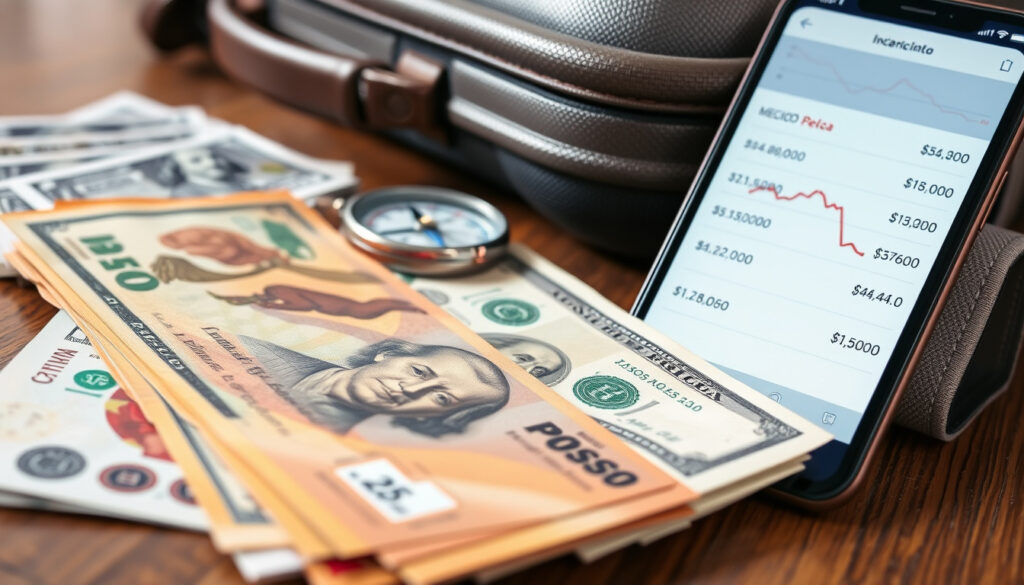
Mexican Peso to USD: Live Rates and Travel Value
Exchanging dollars for pesos can feel like a guessing game, but knowing the mid-market rate and real-world costs protects your wallet. This guide combines live rates, actual buying power, and local tipping norms so you can travel with confidence.
Current MXN to USD rate: 1 MXN = 0.0577 USD ·
$100 USD to MXN: Approximately 1,733 MXN ·
$100 MXN to USD: Approximately $5.77 USD
Quick snapshot
- 1 MXN = 0.0577 USD (Banco de México (Mexico’s central bank))
- 1 USD = 17.33 MXN (Trading Economics (financial data provider))
- Rates update in real-time (Wise (currency conversion platform))
- Use online converters like Revolut (digital banking service) or XE
- Avoid airport exchange booths for poor rates (Revolut (digital banking service))
- Consider fee-free ATM withdrawals (AFAR (travel magazine))
- $100 USD ≈ 1,733 MXN (Trading Economics (financial data provider))
- Average meal: 100-200 MXN (The Real Deal Tours (Mexico travel guide))
- Pint of beer: 30-50 MXN (Villa Experience (Mexico travel guide))
- Restaurants: 10-15% (AFAR (travel magazine))
- Tour guides: 50-100 MXN (The Real Deal Tours (Mexico travel guide))
- $20 USD is an exceptionally big tip (Bacon Is Magic (Mexico travel blog))
Five key facts, one pattern: the mid-market rate gives a baseline, but the real-world value depends on fees, location, and spending habits.
| Metric | Value | Source |
|---|---|---|
| Exchange rate (mid-market) | 1 MXN = $0.0577 USD | Wise |
| 100 MXN | $5.77 USD | Calculated from mid-market rate |
| 100 USD | 1,733 MXN | Investing.com (financial markets platform) |
| Average beer price | 30-50 MXN | Estimate from travel guides |
| Common tip amount | 10-15% of bill | Bacon Is Magic (Mexico travel blog) |
How much is $100 peso in US dollars?
What is the current MXN to USD exchange rate?
- Current mid-market rate: 1 MXN = $0.0577 USD (Wise)
- Banco de México (Mexico’s central bank) publishes the FIX reference rate daily, but it is not an intraday live retail quote
- The trading market rate (USD/MXN) was around 17.23 as of June 2026 (Trading Economics)
To convert pesos to dollars, multiply the peso amount by 0.0577. For example, 100 MXN × 0.0577 = $5.77 USD. Banks and money transfer services add their own fees, so the actual rate you receive will differ — sometimes by several percentage points (Revolut).
The official Banco de México FIX rate is a valuation benchmark, not a retail rate. Travelers who rely on it as the “real” rate will overestimate how many pesos they actually receive after fees.
How to convert Mexican pesos to US dollars
- Online converters like Wise or XE give live mid-market rates
- Always add a fee buffer: expect 1–3% for credit cards and 5–10% for airport booths
- Withdrawing from a local ATM in Mexico often gives a better rate than exchanging cash
The implication: the difference between a “good” rate and a “bad” rate on a $500 USD withdrawal can be 100–300 MXN — a sit-down meal for two.
How much is $100 US in Mexico today?
How much is $100 USD in Mexican pesos?
- 100 USD = 1,733 MXN at the current mid-market rate (1 USD ≈ 17.33 MXN)
- Rates change daily; check a live converter like Investing.com
- Avoid currency exchange at airports — rates can be 5–10% worse than mid-market
The Mexican peso strengthened 0.47% over the month prior to June 2026 (Trading Economics), so the buying power of $100 USD fluctuates noticeably week to week.
What affects the USD to MXN rate?
- Monetary policy decisions from Banco de México (Mexico’s central bank) influence the peso’s direction
- Trade balances, oil prices, and US interest rates all play a role
- Banco de México’s August 2025 statement noted the peso fluctuated without a definite trend
The pattern: short-term movements are hard to predict, but the peso tends to gain in periods of high Mexican exports and lose during US economic strength.
Is $100 a lot of money in Mexico today?
How much money do you need per day in Mexico?
- Average meal costs 100-200 MXN (roughly $5.75–$11.50 USD)
- A pint of beer is 30-50 MXN ($1.70–$2.90 USD)
- Budget travelers often get by on $30–$50 USD per day excluding accommodation
$100 USD (≈1,733 MXN) is a significant sum in Mexico — more than the daily minimum wage in most states. The The Real Deal Tours (Mexico travel guide) notes that a generous daily budget for a comfortable trip is about 1,500–2,000 MXN per person.
$100 USD covers a day of meals, drinks, tips, and local transport — but if you’re staying at a mid-range hotel or a resort, accommodation alone can eat that sum before breakfast.
Comparing $100 to local income and expenses
- 200 MXN is about $11.50 USD — enough for a nice lunch with a drink
- Many locals in formal restaurants leave around 10% tip (Bacon Is Magic)
- For travelers, $100 USD feels like a moderate day’s spending; for a local on an average salary, it’s a meaningful amount
What this means: $100 USD is “a lot” in the sense that it gives you comfortable middle-class consumption for a day — but it’s not so high that you feel wealthy.
Is $20 USD a big tip in Mexico?
What is the tipping etiquette in Mexico?
- Restaurants: 10–15% of the pre-tax bill is standard; 15% is common at nicer tourist spots (The Real Deal Tours)
- Hotel housekeeping: 25–50 pesos per day (AFAR (travel magazine))
- Tour guides: 50–100 MXN per person for a half-day
- $20 USD (≈347 MXN) is an exceptionally large tip — far above what locals would leave
Villa Experience (Mexico travel guide) suggests a standard restaurant tip of 15–20% of the pre-tax bill, so on a 2,000 MXN dinner ($115 USD), 20% would be 400 MXN — still only about $23 USD.
How to tip in pesos vs dollars
- Always tip in Mexican pesos — dollars may be inconvenient for staff to exchange
- Carry small denominations (50 and 100 peso notes) for tips
- Many credit card slips have a line for propina (tip); write in the peso amount
The trade-off: leaving $20 USD might feel generous to you, but it can create awkwardness or confusion if the recipient expected pesos. Stick to local currency in amounts aligned with local norms.
How much is a pint of beer in Mexico?
What is the average price of a pint of beer in Mexico?
- A pint of beer costs 30–50 MXN (approximately $1.70–$2.90 USD)
- In tourist zones like Cancún or Playa del Carmen, prices can be 40–60 MXN
- In local neighborhoods, a pint may be as low as 25 MXN
Beer prices offer a quick temperature check on the cost of living. A 30 MXN pint is about one-fifth the cost of a similar beer in New York City, reflecting the lower wage base and the strength of the peso-dollar exchange rate.
How does beer price reflect overall expenses?
- If a beer costs 40 MXN, that’s roughly the same as the cost of a street taco meal
- Overall daily expenses for a budget traveler often land at 800–1,200 MXN including food, drink, and transport
- The price gap between tourist areas and local spots is substantial — a beer at a resort can be 80–120 MXN
The pattern: beer prices map neatly to the broader divide between tourist and non-tourist pricing in Mexico. Sticking to local spots can cut your daily spending by 30–50%.
Upsides of using pesos in Mexico
- Better value — prices in pesos are almost always lower than the same item paid in dollars
- Local merchants appreciate pesos; you avoid the “dollar price” markup common in tourist areas
- ATM withdrawal with a no-fee card often gives the mid-market rate minus a small fixed fee
- Leaving tips in pesos is expected and more convenient for staff
Downsides of using pesos in Mexico
- Exchange rates can move against you — carry some dollars as backup
- Airport and hotel exchange booths charge large spreads (5–10%)
- Not all US debit cards have fee-free international transactions
- You may end up with leftover pesos at the end of your trip
Travelers who plan to spend primarily in pesos and withdraw from ATMs with a no-fee card come out ahead — but they face currency risk on any dollars they hold until exchange.
How to get the best MXN to USD exchange rate
Step-by-step guide
- Check the live mid-market rate on a reputable platform such as Wise or Investing.com before you travel.
- Compare fees from your bank, a currency exchange service, and an online provider like Revolut — don’t assume your bank gives the best rate.
- Withdraw pesos from an ATM in Mexico using a debit card that waives international fees; decline the ATM’s own conversion offer (let your bank set the rate).
- Avoid airport exchanges — they typically give the worst rates. If you need cash immediately, take a small amount in pesos from a local ATM outside security.
- Pay in local currency when using a credit card — if the merchant offers to charge in dollars, the conversion rate is almost always unfavorable.
For travelers in Mexico, the single biggest savings is declining dynamic currency conversion at every point of sale. That choice alone can save 3–5% on every transaction.
Confirmed facts
- Exchange rate constantly changes, but current mid-market rate is 1 MXN = 0.0577 USD (Wise)
- Typical tipping in Mexico is 10-15% (The Real Deal Tours)
- $20 USD is an exceptionally large tip in the local context (AFAR)
- Banco de México publishes the FIX exchange rate on each banking day (Banco de México)
What’s unclear
- Exact cost of beer may vary by region and establishment; reported range 30–50 MXN is a typical guide, not a guarantee
- Whether $100 is “a lot” depends on individual spending habits and the destination within Mexico
- The precise fee structure for ATM withdrawals and credit card conversions is card- and bank-dependent
- The exact exchange rate at any moment is subject to market fluctuations and may differ from published mid-market rates
“The FIX exchange rate is not an intraday live retail quote but an official reference rate for banking days.”
Banco de México (Mexico’s central bank)
“AFAR recommends leaving 25–50 pesos per day for hotel housekeeping in Mexico, because staff may change each day.”
AFAR (travel magazine)
“Many locals in formal restaurants leave about 10%, while some tourist restaurants suggest 15% or 20% for generous service.”
Bacon Is Magic (Mexico travel blog)
“A standard restaurant tip in Mexico is 15–20% of the pre-tax bill.”
For travelers heading to Mexico, the choice is clear: plan your spending in pesos, use a fee-free ATM card, and tip in local currency at 10–15% in restaurants. Doing anything else means leaving money on the table — or in the exchange booth’s pocket.
Related reading: **USD to INR Rate Today: Live, Forecast & History (2026)** · **BTC USD Current Price: Live Bitcoin Rate & Chart 2025**
Frequently asked questions
What is the best way to convert pesos to dollars?
The best way is to use an online currency converter like Wise or XE to check the mid-market rate, then withdraw pesos from an ATM in Mexico using a fee-free debit card. Avoid airport exchange booths and hotel currency desks, which charge spreads of 5–10%.
Should I exchange money before traveling to Mexico?
It’s generally better to exchange a small amount (e.g., 2,000–3,000 MXN) before you go for immediate expenses, then rely on ATMs for the remainder. Exchanging abroad before you leave often costs less than airport exchange desks.
Is it better to use USD or pesos in Mexico?
Always use pesos for day-to-day purchases and tips. Merchants may accept dollars but often at an unfavorable rate. Paying in pesos ensures you get the local price without a hidden currency markup.
How does the exchange rate fluctuate over time?
The MXN/USD rate moves daily based on trade balances, oil prices, and central bank policy. In 2025, the peso showed a slight strengthening trend, with USD/MXN falling from the high 17s to around 17.23 by mid-2026 (Trading Economics).
What is the current exchange rate for 1,000 MXN?
At the mid-market rate of 1 MXN = 0.0577 USD, 1,000 MXN equals $57.70 USD. Actual rates received will be slightly lower after fees.
Are there any fees when using ATMs in Mexico?
Yes. Mexican ATMs may charge a withdrawal fee (usually 30–50 MXN), and your home bank may charge an international transaction fee. Cards from banks like Charles Schwab or Revolut often rebate these fees. Always decline the ATM’s dynamic currency conversion offer.
More related posts
 How to File Taxes in Ireland: A Step-by-Step Guide (2025)
 Hou e of Guinne Ca t: Full Guide to the Netflix Serie
 Rest Area Near Me: Google Maps Guide & Ireland Motorway Stops
 How to Use Noise Cancellation on AirPods: Pro, 4 & Android
 Lakers vs Timberwolves Match Player Stats – Detailed Breakdown
 GLP-1 Weight Loss – Drugs, Results, Side Effects Guide
 Circle K Near Me: Find Stations, Hours & Services in Ireland
 Batman (1989 film): Cast, Review, Age Rating & Why It’s Iconic