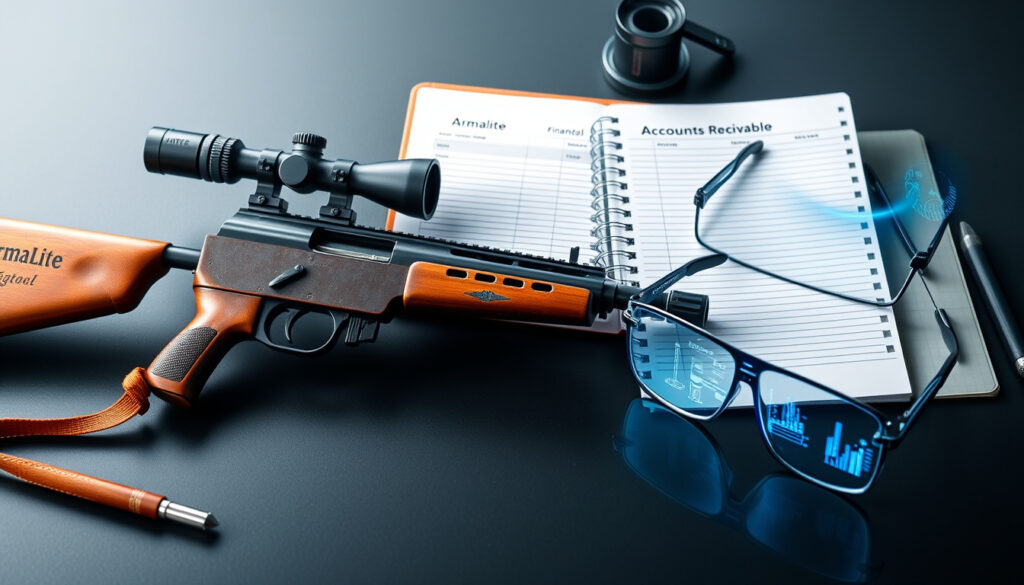
AR Stand For: ArmaLite, Account Receivable, Augmented Reality
Few acronyms carry as much confusion as “AR.” Ask ten people what it stands for, and you’ll get different answers — and more often than not, the wrong one. The truth is that AR means different things depending on context: in firearms it’s ArmaLite Rifle, in business it’s accounts receivable, and in tech it’s augmented reality.
AR stands for: ArmaLite Rifle ·
Common misconception: Assault rifle (incorrect) ·
First introduced: 1956 ·
Caliber: .223 Remington / 5.56 NATO ·
Action: Semi-automatic, gas-operated
Quick snapshot
- AR in AR-15 stands for ArmaLite Rifle (National Shooting Sports Foundation)
- AR-15 is a semi-automatic, gas-operated rifle (Wikipedia)
- Designed by Eugene Stoner in 1956 (Wikipedia)
- Not an assault rifle — AR does not mean “assault rifle” or “automatic rifle” (National Shooting Sports Foundation)
- AR stands for accounts receivable
- Money owed by customers for goods/services delivered
- Current asset on company balance sheet
- Key metric for cash flow and business liquidity
- Overlays digital information onto real-world view
- Used in games, navigation, retail, and training
- Different from virtual reality (fully immersive)
- Examples: Pokémon GO, Snapchat filters, Google Maps Live View
- K-12 reading program developed by Renaissance Learning
- Students earn points for reading and passing comprehension quizzes
- Tracks reading progress and comprehension levels
- Used widely in US schools
What does AR stand for in AR-15?
AR in AR-15 stands for ArmaLite Rifle, named after the company that created the design in the 1950s. The National Shooting Sports Foundation (NSSF) states clearly that “AR does not stand for ‘assault rifle’ or ‘automatic rifle.'” The AR-15 is a semi-automatic firearm that fires one bullet per trigger pull — not a fully automatic military weapon.
Myth vs fact: AR stands for ArmaLite
The confusion stems from the visual similarity between the AR-15 and military rifles like the M16 or M4. A Campbell University Law Review article notes that the civilian AR-15 “looks like a fully automatic military M4 carbine or M16 rifle but is semiautomatic.” The same source explains that “assault rifle” is a military term for a selective-fire weapon — one that can switch between semi-automatic and fully automatic modes. The AR-15 is not selective-fire in its civilian configuration.
What does the ‘r’ mean in AR-15?
The “r” in AR-15 does not have an official separate meaning. The full designation — ArmaLite Rifle model 15 — was the company’s naming convention. Some sources suggest the “r” informally stands for “rifle,” but the AR-15 name originates from the company: ArmaLite Rifle 15.
“The actual meaning of the acronym AR is ArmaLite Rifle.”
— Hunter-ed.com
What’s the difference between an AR, AK and just a rifle?
The AR-15 and AK-47 are two of the most recognizable firearm platforms in the world, but they differ in design philosophy, mechanics, and history. Understanding these differences clarifies why “rifle” alone does not capture the distinction.
AR-15 vs AK-47: key differences
| Feature | AR-15 | AK-47 |
|---|---|---|
| Full name | ArmaLite Rifle model 15 | Avtomat Kalashnikova 1947 |
| Designer | Eugene Stoner | Mikhail Kalashnikov |
| Caliber | .223 Remington / 5.56 NATO | 7.62×39mm |
| Action | Gas-operated, semi-automatic (civilian) | Gas-operated, selective fire (military) |
| Reliability | Requires regular cleaning | Known for reliability in adverse conditions |
| Accuracy | Generally more accurate at range | Less accurate; designed for volume of fire |
| Year introduced | 1956 | 1949 |
The implication: The AR-15 prioritizes accuracy and modularity; the AK-47 prioritizes reliability and simplicity. Neither is inherently “better” — they serve different design goals and user contexts.
What does AK-47 stand for?
AK-47 stands for Avtomat Kalashnikova 1947 — Russian for “Kalashnikov’s automatic” and the year of its design. Unlike the AR-15, the AK-47 was originally designed as a selective-fire infantry rifle capable of fully automatic fire. The civilian variants have been modified to semi-automatic only.
What does M16 stand for?
M16 is the U.S. military designation for the select-fire version of the ArmaLite/Colt rifle design. The Wikipedia article on AR-15–style rifles notes that the original ArmaLite AR-15 was a scaled-down derivative of the AR-10 design by Eugene Stoner. The Colt AR-15 removed the selective-fire feature for the civilian market. The M16, adopted by the U.S. military in the 1960s, retained full-auto capability.
Timeline: from AR-10 to M16
- 1954: ArmaLite founded
- 1956: AR-10 developed by Eugene Stoner
- 1959: ArmaLite sells AR-15 design to Colt
- 1963: Colt introduces semi-automatic civilian AR-15 (Wikipedia)
- 1964: U.S. Air Force adopts the rifle as the M16
- 1977: Colt patents the semi-automatic AR-15 for the civilian market
- 2004: Colt’s patents expire; many manufacturers begin producing AR-15 variants
The pattern: The civilian AR-15, military M16, and modern sporting rifle market all trace back to one ArmaLite design. The military variant gained full-auto capability; the civilian version remained semi-automatic.
“The term ‘modern sporting rifle’ was coined by the National Shooting Sports Foundation in 2009 as a marketing term for modular semi-automatic rifles including AR-15s.”
— Wikipedia
What does AR mean for work?
In business and finance, AR stands for accounts receivable — the money owed to a company by its customers for goods or services delivered on credit. Companies track AR as a current asset on the balance sheet, representing expected incoming cash. It is a key metric for assessing cash flow, liquidity, and financial health.
Accounts receivable definition
Accounts receivable arises when a company sells products or services but allows customers to pay later. The amount owed appears as an asset because the company has a legal claim to that money. AR management involves tracking invoices, collecting payments, and minimizing delinquencies.
AR in accounting
In accounting, AR is recorded as a debit to accounts receivable and a credit to revenue at the time of sale. When the customer pays, the company debits cash and credits accounts receivable. The ratio of AR to total revenue gives insight into payment cycles and customer reliability.
What does AR stand for in technology?
In technology, AR most commonly means augmented reality — the overlay of digital information onto the real-world environment. Unlike virtual reality, which immerses the user in a completely synthetic world, augmented reality enhances the existing environment with computer-generated elements.
Augmented reality (AR)
Augmented reality overlays digital content such as images, text, or 3D models onto a live view of the physical world. Common applications include smartphone games (Pokémon GO), navigation aids (Google Maps Live View), retail try-on features (IKEA Place), and industrial training simulations. AR differs from VR in that it does not replace the user’s surroundings; it adds to them.
Accelerated Reader (AR) in education
In education, AR stands for Accelerated Reader, a reading program developed by Renaissance Learning for K-12 students. The program assigns points based on book difficulty and reading comprehension. Students read books, take quizzes, and earn points — teachers track progress to guide reading levels. It is widely used in U.S. schools as a literacy assessment tool.
“The name ‘AR’ is not an abbreviation for ‘assault rifle.'”
— ABC7 Chicago
Upsides of understanding AR
- Accurate communication in firearms, finance, and tech
- Debunks the common myth about the AR-15
- Provides clarity in business accounting contexts
- Enables informed discussion about augmented reality applications
Downsides of AR confusion
- Misidentification of the AR-15 as an assault weapon
- Misunderstandings in business transactions
- Confusion between augmented reality and virtual reality
- Loss of credibility when using the term incorrectly
For a deeper look at how Augmented Reality applications across industries are transforming business sectors, the overview on InFact provides excellent real-world examples.
Frequently Asked Questions
Is the AR-15 fully automatic?
No. The civilian AR-15 is semi-automatic — it fires one round per trigger pull. The National Shooting Sports Foundation confirms that AR-15s are not fully automatic weapons.
What is the effective range of an AR-15?
The effective range of an AR-15 shooting .223 Remington/5.56 NATO ammunition is typically 400–600 meters for point targets, depending on barrel length and optics. Maximum effective range against area targets extends to roughly 800 meters.
Can civilians legally own an AR-15?
Yes, in most U.S. states and under federal law, civilians can legally purchase and own semi-automatic AR-15s, subject to state and local regulations. Some states impose restrictions on magazine capacity, features, or require permits.
What is the difference between AR-15 and M4?
The M4 is a selective-fire carbine used by the U.S. military. It can fire in semi-automatic, burst, or fully automatic modes. The civilian AR-15 is semi-automatic only and lacks the M4’s burst/auto capability and heavier barrel profile.
Why is the AR-15 called a modern sporting rifle?
The National Shooting Sports Foundation coined the term “modern sporting rifle” (MSR) in 2009 as a marketing and educational term for semi-automatic rifles including the AR-15. The term emphasizes their use in sport shooting, hunting, and civilian ownership.
What does the ’15’ in AR-15 stand for?
The “15” in AR-15 is the model number assigned by ArmaLite. It follows the AR-10, which was the company’s earlier design in 7.62mm NATO caliber.
Is the AK-47 more reliable than the AR-15?
The AK-47 is known for reliability under adverse conditions — dirt, sand, and lack of maintenance. The AR-15 operates reliably when maintained clean and lubricated. The difference reflects design philosophy: the AK tolerates fouling via looser tolerances; the AR requires more care for consistent function.
More related posts
 Clyde Edwards-Helaire: PTSD, Playing Status, and 2026 Outlook
 Is It Normal to Bleed After Sex? Causes, Signs & When to Worry
 30 Days From Now: Calculator, Steps & Leap Year Guide
 Which Author Is Responsible for Sharing Reprints with Readers
 What Is Pantoprazole Used For? Uses, Side Effects & Dosage
 Jimmy John’s Promo Code Guide: 20% Off & More
 The Secret: Dare to Dream: Plot, Cast, True Story & Where to Watch
 Las guerreras K-pop: Real Singers, Songs & Full Guide