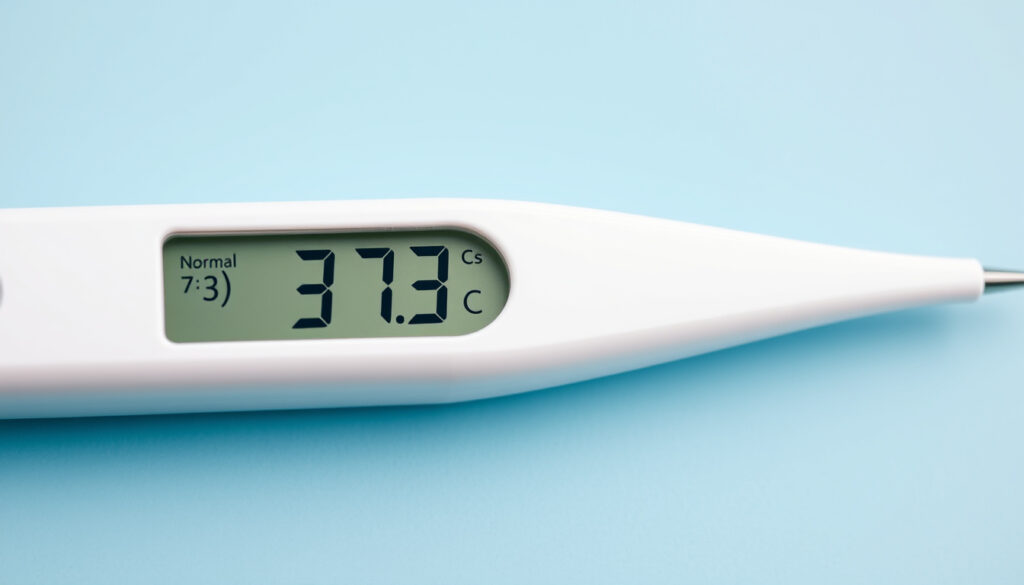
37.3 C to F: Conversion, Normal Temperature, and Fever Context
Anyone who has seen 37.3°C on a thermometer and wondered whether it means something is already familiar with the small anxiety that number can trigger. The exact conversion to Fahrenheit — 99.14°F — sits just above the classic 98.6°F average, but medical guidelines show that normal body temperature covers a wider range than many people realize.
Conversion formula: °F = (°C × 9/5) + 32 ·
37.3°C in Fahrenheit: 99.14°F ·
Average normal body temperature: 98.6°F (37°C) ·
Typical adult body temperature range: 97°F–99°F (36.1°C–37.2°C)
Quick snapshot
- 37.3°C = 99.14°F (NCBI Bookshelf (StatPearls))
- Formula: °F = (°C × 1.8) + 32 (NCBI Bookshelf (StatPearls))
- Check using online calculator or manual math (NCBI Bookshelf (StatPearls))
- Adults oral: 97°F–99°F (36.1°C–37.2°C) (Mayo Clinic)
- Children similar, but higher range in infants (Mayo Clinic)
- Varies by time of day, activity (Mayo Clinic)
- Fever = core temperature ≥100.4°F (38°C) (NHS (UK national health authority))
- Axillary readings often lower (NHS (UK national health authority))
- 37.3°C armpit may not indicate fever (NHS (UK national health authority))
- Persistent fever >100.4°F
- Symptoms like confusion, difficulty breathing
- Consult healthcare provider if unsure
The key facts that frame the 37.3°C question at a glance:
| Fact | Value |
|---|---|
| 37.3°C in Fahrenheit | 99.14°F |
| Average normal (oral) | 98.6°F (37°C) |
| Normal adult range (oral) | 97°F–99°F (36.1°C–37.2°C) |
| Fever threshold (core) | ≥100.4°F (38°C) |
| Axillary temperature offset | 0.5°C–1°C lower than core |
What is 37.3 C to F?
Formula for converting Celsius to Fahrenheit
- Start with the Celsius temperature: 37.3°C
- Multiply by 9/5 (or 1.8): 37.3 × 1.8 = 67.14
- Add 32: 67.14 + 32 = 99.14°F
The formula °F = (°C × 9/5) + 32 is the standard conversion used in science and medicine worldwide (NCBI Bookshelf (StatPearls)).
Step-by-step conversion of 37.3°C
To double-check, you can also use the inverse: subtract 32 from the Fahrenheit value, then multiply by 5/9. For 37.3°C, the math is straightforward and always yields 99.14°F (Wikipedia (Celsius scale)).
Is 37.3 C a normal temperature?
Typical body temperature range for adults
- Oral temperature: 97°F–99°F (36.1°C–37.2°C) (Mayo Clinic (US academic medical center))
- Average oral: 98.6°F (37°C) (MedlinePlus (US National Library of Medicine))
- StatPearls notes that normal temperature varies by about 0.5°C throughout the day (NCBI Bookshelf (StatPearls)).
At 37.3°C, you are 0.1°C above the upper end of the typical oral range. That alone does not make it a fever, but it places you in a borderline zone where individual factors matter.
Factors affecting body temperature
Harvard Health Publishing explains that normal body temperature varies from person to person and changes during the day (Harvard Health Publishing). Time of day, recent exercise, menstrual cycle, and even room temperature can shift a reading. A morning temperature of 37.3°C is more likely to be normal than one taken in the evening, when body temperature naturally peaks.
A single 37.3°C reading without symptoms is rarely a red flag. The pattern over 24 hours and the presence of other signs — chills, aches, fatigue — carry more weight than the number alone.
Is 37.3 Celsius a fever armpit?
Axillary temperature norm vs fever threshold
- Armpit (axillary) temperatures are typically 0.5°C–1°C lower than core body temperature (Mayo Clinic).
- Mayo Clinic states that an armpit temperature of 37.2°C or higher can be considered a fever (Mayo Clinic).
- Medical News Today reports that some guidelines place the fever threshold for children over 3 months at 38.5°C or more (Medical News Today (health news outlet)).
Because axillary readings are lower, a 37.3°C under-arm measurement may correspond to a core temperature around 37.8°C–38.3°C. That is still below the 38°C fever threshold used by most authorities, but it is close enough to warrant attention if other symptoms exist.
Importance of measurement site
The site matters enormously. Rectal and ear (tympanic) temperatures track core temperature most closely. Oral and temporal artery readings are middle ground. Armpit and forehead (non-contact) readings are the least reliable. When you see 37.3°C, always ask: where was it measured?
Is 37.3 considered a fever in adults?
Medical definition of fever in adults
- NHS (UK national health authority) defines a high temperature as 38°C or above (NHS).
- Harvard Health classifies 37.3°C to 38.0°C as low-grade fever (Harvard Health Publishing).
- Cleveland Clinic notes that many providers define fever as either 37.8°C (100.0°F) or 38.0°C (100.4°F) (Cleveland Clinic (US medical center)).
- StatPearls states there is no single universally accepted cutoff for fever (NCBI Bookshelf (StatPearls)).
The variation among guidelines means that 37.3°C lives in a gray zone. Whether it is called a low-grade fever or a normal high reading depends on the institution and the clinical context.
When to seek medical attention
NHS Inform says fever in adults is usually 38°C or higher (NHS Inform (Scottish health authority)). However, if 37.3°C is accompanied by severe headache, stiff neck, difficulty breathing, confusion, or persistent vomiting, those symptoms warrant a call to a healthcare provider regardless of the number.
A 37.3°C reading in an adult with no other symptoms is rarely actionable on its own. But for older adults, infants, or people with weakened immune systems, the threshold for concern drops. In those groups, even a borderline temperature can signal an infection that needs evaluation.
What is the normal body temperature in C to F?
Conversion chart for common body temperatures
The pattern from low-normal to fever range illustrates how a single degree can shift clinical context.
| Celsius | Fahrenheit | Context |
|---|---|---|
| 36.0°C | 96.8°F | Low-normal, often morning reading |
| 36.5°C | 97.7°F | Common average |
| 37.0°C | 98.6°F | Classic average normal |
| 37.3°C | 99.14°F | Borderline high-normal / low-grade |
| 37.8°C | 100.0°F | Alternate fever threshold |
| 38.0°C | 100.4°F | Standard fever threshold |
| 39.0°C | 102.2°F | Moderate fever |
Interpreting values across scales
The conversion table shows that 37.3°C is just 0.3°C above the classic average. WebMD notes that a normal adult temperature is typically 97°F to 99°F (WebMD (health information publisher)). Within that range, 99.14°F is at the high end but still inside the boundary for many healthy adults.
Clarity
Confirmed facts
- 37.3°C = 99.14°F (NCBI Bookshelf)
- Normal adult oral range is 36.1°C–37.2°C (97°F–99°F) (Mayo Clinic)
- Fever is typically defined as ≥38°C (100.4°F) core (NHS)
- Axillary readings are 0.5°C–1°C lower than core (Mayo Clinic)
What’s unclear
- Whether 37.3°C armpit reading indicates fever depends on individual baseline and measurement technique
Expert perspectives
“Normal body temperature can range from 36.1°C to 37.2°C or more, depending on the person and the method used.”
— Mayo Clinic
“A high temperature in adults is usually 38°C or above.”
— NHS (UK national health authority)
“There is no single universally accepted cutoff for fever.”
— NCBI Bookshelf (StatPearls) (medical reference database)
For anyone monitoring their temperature at home, the implication is clear: if your reading is 37.3°C, consider the measurement method and time of day before deciding it means something. An oral reading of 37.3°C in the evening is less concerning than the same number under the arm in the morning. For a healthy adult without symptoms, the evidence says watch and wait. For an infant, an older adult, or someone with a chronic condition, the same number calls for a conversation with a healthcare provider — because context, not a single conversion, determines the real risk.
Related reading: What Is Room Temperature? Ideal Home & Sleep Temp Guide · 6 Inches to cm – Exact Conversion & Common Mistakes
Frequently asked questions
What is the formula to convert Celsius to Fahrenheit?
°F = (°C × 9/5) + 32. For 37.3°C: 37.3 × 1.8 = 67.14, plus 32 = 99.14°F.
Is 37.3°C a fever for a baby?
In infants, fever is often defined as a rectal temperature of 38°C or higher. A 37.3°C reading is not a fever, but parents should monitor for other symptoms and consult a pediatrician if concerned.
How does measurement site affect temperature reading?
Rectal and ear readings are closest to core temperature. Oral and temporal artery are intermediate. Axillary (armpit) readings are typically 0.5°C–1°C lower than core.
Can 37.3°C be a fever if measured under the arm?
Mayo Clinic considers an armpit temperature of 37.2°C or higher as a potential fever. However, because axillary readings are lower than core, the actual core temperature may be higher. Context and symptoms matter.
What should I do if my temperature is 37.3°C?
If you have no other symptoms, rest and recheck later. If you feel unwell, have a persistent cough, or are in a high-risk group, contact a healthcare provider.
Is 37.4°C a fever after taking paracetamol?
Paracetamol lowers fever. A reading of 37.4°C after medication may indicate the fever is partially controlled. Continue monitoring and follow the dosing instructions. Seek medical advice if symptoms worsen.
What is 37°C in Fahrenheit?
37°C = 98.6°F, the classic average normal body temperature.
What is 38°C in Fahrenheit?
38°C = 100.4°F, the standard fever threshold for adults.
More related posts
 Food Truck Near Me: Costs, Menus & Locations in Ireland
 How to File Taxes in Ireland: A Step-by-Step Guide (2025)
 Days of Our Lives Spoilers: 2026 Cast Shakeup
 Venom: Let There Be Carnage – Reviews, Streaming Guide
 Tiger v Rockie Match Player Stat : Key Number
 Pope John Paul I – 33-Day Reign, Death Mystery and Beatification
 What Is VPN Split Tunneling? Benefits, Risks, and How to Check
 T-Mobile Bill Pay – Guest Payments No Login Needed