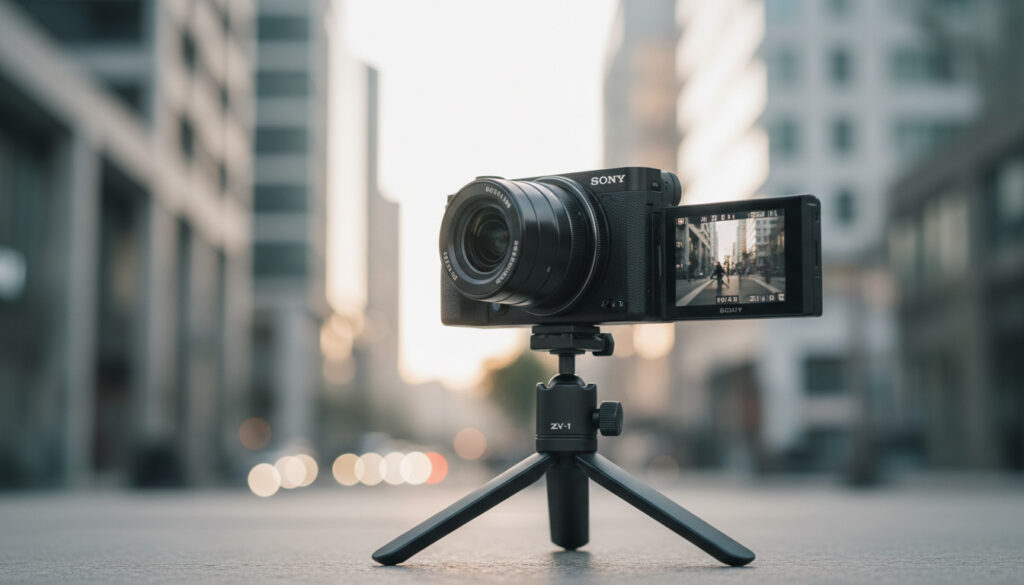
Sony ZV-1 – Full Specs Features and Vlogging Guide
The Sony ZV-1 is a compact digital camera released in 2020, specifically engineered for content creators and vloggers. It combines a 20.1-megapixel 1-inch sensor with a fixed 24-70mm equivalent Zeiss lens and 4K video capabilities in a pocketable form factor. Unlike traditional compact cameras, the ZV-1 prioritizes front-facing usability with a fully articulating touchscreen and specialized audio hardware.
Positioned as Sony’s first dedicated vlogging camera, the ZV-1 borrows core imaging technology from the RX100 series but reconfigures the physical interface for single-operator video work. The absence of a viewfinder and the inclusion of a three-capsule directional microphone distinguish it from photography-oriented alternatives.
Despite the 2023 release of the successor ZV-1 II, the original ZV-1 remains widely available through major retailers in 2024-2025, typically priced between $500 and $750 depending on condition and bundled accessories.
What Is the Sony ZV-1?
- Designed specifically for vloggers with a side-mounted flip-out screen for selfie framing
- Real-time Eye Autofocus tracks human and animal subjects during video recording
- One-touch background defocus button creates instant bokeh without menu navigation
- No electronic viewfinder; reliance on LCD screen for all composition
- Three-capsule directional microphone with included wind noise reduction accessories
- Product Showcase mode rapidly shifts focus from face to objects held toward the lens
- Predecessor to the ZV-1 II, maintaining relevance through aggressive pricing
| Feature | Details |
|---|---|
| Price Range (2024-2025) | $500–$750 |
| Weight | 294 grams |
| Battery Life (CIPA) | 260 shots (LCD on) / 410 shots (auto-off 2s) |
| Video Recording Time | Approximately 45 minutes continuous |
| Screen | 3-inch fully articulating touchscreen LCD |
| Maximum Video Resolution | 4K UHD at 30fps, Full HD at 120fps |
| Lens Specification | 24-70mm equivalent, f/1.8–2.8 Zeiss Vario-Sonnar T* |
| Image Processor | BIONZ X |
| Stabilization | SteadyShot Active mode (electronic) |
| Audio Input | 3.5mm stereo mini jack, multi-interface hot shoe |
| Connectivity | Clean HDMI output, USB streaming capability |
| Internal Filter | Built-in ND filter (1/4) |
Sony ZV-1 Key Specifications and Features
Imaging Hardware
The ZV-1 utilizes a 20.1-megapixel 1-inch Exmor RS CMOS sensor paired with Sony’s BIONZ X image processor. This combination delivers RAW and JPEG stills with dynamic range comparable to the RX100 V, though the camera tunes color science toward skin tone accuracy for video work. The fixed Zeiss 24-70mm equivalent lens features a T* anti-reflective coating to minimize flare during backlight shooting.
Video Capabilities
Video recording reaches 4K Ultra HD at 30 frames per second with full pixel readout and no pixel binning. Full HD options extend to 120fps for slow-motion work, while a high-frame-rate mode captures up to 960fps at reduced resolution (1244×420) for extreme temporal effects. The camera supports HLG (Hybrid Log-Gamma) and S-Log2/3 profiles for grading flexibility, along with zebra patterns and focus peaking for exposure and focus monitoring. According to DPReview’s technical analysis, rolling shutter artifacts remain minimal during normal motion.
Autofocus Performance
Hybrid autofocus combines phase-detection and contrast-detection points with Real-Time Tracking algorithms. Eye AF functions for both humans and animals, maintaining lock during movement. Face-priority autoexposure prevents backlighting from silhouetting subjects in variable lighting conditions. Touch focusing allows rapid subject selection on the articulating screen.
Audio System
The integrated three-capsule microphone captures directional audio while attenuating off-axis sound. A supplied windscreen reduces environmental noise during outdoor recording. The multi-interface hot shoe permits cable-free attachment of compatible external microphones such as the ECM-G1, while a 3.5mm input accommodates third-party audio sources. As noted by technical reviewers, the internal microphone quality exceeds typical compact camera implementations.
Real-world battery performance significantly trails official CIPA ratings. While Sony specifies 260 shots per charge for stills, mixed video and vlogging use typically drains the NP-BX1 cell within one to two hours of active shooting with the screen continuously active. Street photographers operating the camera for eight-hour sessions report carrying four spare batteries to maintain coverage.
Is the Sony ZV-1 Good for Vlogging?
Ergonomics for Solo Operation
The physical design prioritizes handheld selfie recording. The side-hinged 3-inch touchscreen flips forward 180 degrees, allowing operators to monitor framing while addressing the lens. Unlike selfie-style flip-up screens, this configuration prevents interference with mounted microphones or tripod plates. The grip surface provides adequate purchase for single-handed operation, though extended use benefits from a secondary hand or rig.
Stabilization Trade-offs
SteadyShot electronic stabilization reduces handheld shake but imposes significant field-of-view crops, particularly problematic in 4K recording where the crop narrows the effective focal length. At arm’s length, this reduction can compromise headroom in selfie framing. Technical documentation confirms that Active mode crops the wide-angle perspective substantially, suggesting the use of external gimbals for smooth walking footage.
Specialized Vlogging Modes
Product Showcase mode temporarily disables face priority, allowing instant focus transition to objects presented toward the camera—useful for product reviews and unboxing content. Background Defocus provides one-button toggling between maximum aperture isolation and stopped-down clarity, functioning by adjusting aperture and ISO simultaneously to maintain exposure.
High-Frame-Rate Limitations
The 960fps slow-motion capability requires pre-buffering and delivers reduced resolution at 1244×420 pixels. Laboratory testing indicates significant noise generation in dim environments when utilizing high-frame-rate modes, restricting their utility to well-lit scenarios.
Sony ZV-1 vs ZV-1 II: Key Differences
The ZV-1 II, released in 2023, iterates on the original formula with meaningful hardware changes while maintaining the core vlogging focus. The most significant distinction involves the lens specification: the Mark II adopts an 18-50mm equivalent f/1.8-4 Zeiss lens, trading telephoto reach for expanded wide-angle coverage beneficial for handheld selfie work.
The original ZV-1’s 24mm equivalent wide end requires arm extension or selfie sticks for inclusive framing, while the ZV-1 II’s 18mm equivalent captures broader environmental context at standard holding distance. However, the Mark II’s variable aperture darkens to f/4 at the telephoto end, reducing low-light capability compared to the original’s f/2.8 constant.
Video specifications diverge at the frame rate level. The ZV-1 tops at 4K/30p, whereas the successor adds 4K/60p recording for smoother motion and enhanced slow-motion potential. The ZV-1 II also improves upon the touchscreen interface and menu navigation, addressing complaints regarding the original’s menu complexity.
As of 2024-2025, the original ZV-1 commands approximately $500–$700 on the new and used market, while the ZV-1 II typically sells for $800–$900. For creators prioritizing 4K/60p or requiring wider angle coverage without accessories, the premium may justify the upgrade. Budget-constrained vloggers or those satisfied with 30fps output retain a capable tool in the original model.
Both cameras share the NP-BX1 battery with similar endurance limitations, though the ZV-1 II demonstrates marginally improved efficiency. Neither offers in-body image stabilization, relying instead on electronic SteadyShot with attendant cropping. Long-term user reports indicate the original ZV-1 maintains competitive image quality despite the generational gap.
Sony ZV-1 Timeline and Availability
- : Sony launches the ZV-1 as the inaugural model in the ZV-series, targeting the emerging creator economy with vlog-specific hardware.
- : Firmware updates address operational stability and autofocus algorithms, though Sony provides no major feature additions during this period.
- : Sony releases the ZV-1 II, repositioning the original as the budget entry point in the lineup.
- : The ZV-1 remains available new through retailers including Amazon and B&H Photo, with robust secondary market activity supporting sub-$500 pricing for used units.
Established Facts and Remaining Uncertainties
Verified Specifications
- 20.1-megapixel 1-inch sensor with BIONZ X processor
- 4K video recording limited to 30 frames per second
- 260-shot CIPA battery rating for still photography
- Current retail availability through major electronics vendors
- Multi-interface hot shoe compatibility with proprietary microphones
Unconfirmed Elements
- Future firmware development schedule beyond current maintenance
- Official discontinuation timeline from Sony manufacturing
- Regional stock level stability for continued new-unit sales
- Long-term support duration for repair and parts availability
The ZV-1 in Content Creation Context
Sony developed the ZV-1 to occupy the space between smartphone convenience and interchangeable-lens complexity. The camera appeals to operators requiring shallow depth-of-field and optical zoom capabilities impossible with mobile devices, while rejecting the bulk and learning curve of mirrorless systems. Best vlogging cameras 2025 comparisons consistently position the ZV-1 as the optimal entry point for verified image quality in a pocketable form.
The fixed lens configuration limits focal length flexibility, constraining telephoto reach and ultra-wide options. Creators requiring landscape photography or distant subject isolation must accept digital cropping or accessory lenses. The absence of an electronic viewfinder further reinforces the video-first design, potentially frustrating photographers accustomed to eye-level composition.
For street photography and discrete imaging, the compact profile and silent electronic shutter enable unobtrusive capture. Field testing confirms the camera’s viability for documentary work, though battery logistics require careful management during extended urban shooting sessions.
Expert Evaluations and Testing Sources
Technical evaluation from Digital Photography Review highlights the ZV-1’s exceptional autofocus reliability during video capture, specifically praising the Real-Time Tracking consistency in walk-and-talk scenarios. Their laboratory measurements confirm minimal rolling shutter distortion relative to sensor size constraints.
Video production analysis by Videomaker emphasizes the microphone quality and wind-noise reduction as class-leading for integrated audio solutions, though recommending external microphones for professional dialogue recording.
Long-term usage studies from Compact Shooter document the camera’s continued relevance for photography applications beyond its vlogging design mandate, noting the lens sharpness and RAW file versatility.
Current Market Assessment
The Sony ZV-1 represents a compelling value proposition for entry-level content creators prioritizing autofocus reliability and audio quality over extended battery life and lens flexibility. While the Sony ZV-1 II review highlights meaningful upgrades for those requiring 4K/60p or wider angle coverage, the original model delivers sufficient capability for standard vlogging workflows at significantly reduced cost. Prospective buyers should budget for multiple NP-BX1 batteries and consider the lack of in-body stabilization when planning handheld movement sequences.
Frequently Asked Questions
Is the Sony ZV-1 discontinued?
Sony has not issued official discontinuation notices for the ZV-1 as of 2024-2025. The camera remains available new through major retailers including Amazon and B&H Photo, typically priced between $500 and $750. While the ZV-1 II successor has entered the market, the original continues production alongside it as a budget-tier option.
Are firmware updates still available for the Sony ZV-1?
Sony maintains firmware support for the ZV-1 through their official support portal. While no specific feature-adding updates have been announced recently, the multi-function hot shoe receives ongoing compatibility maintenance. Users should verify current firmware versions via the Sony support website for optimal stability.
Does the Sony ZV-1 record 4K at 60fps?
No. The ZV-1 supports 4K video recording exclusively at 24p and 30p frame rates. Full HD recording extends to 120fps. Creators requiring 4K/60p must consider the ZV-1 II or alternative camera systems.
Is the Sony ZV-1 suitable for photography?
Yes. The 20.1-megapixel sensor and Zeiss lens produce RAW and JPEG images with detail matching the RX100 V. The lack of a viewfinder and the articulated screen design favor specific genres like street photography and macro work, though battery limitations constrain extended shooting sessions.
What battery does the Sony ZV-1 use?
The camera utilizes the Sony NP-BX1 lithium-ion battery. CIPA ratings indicate 260 shots per charge with the LCD active, or approximately 45 minutes of continuous video recording. Real-world vlogging use typically requires battery replacement every one to two hours.
Can lenses be changed on the Sony ZV-1?
No. The ZV-1 features a fixed, non-removable 24-70mm equivalent Zeiss lens. The lens retracts into the body when powered off. Users requiring interchangeable lenses must consider Sony’s mirrorless E-mount systems.
Does the Sony ZV-1 have a viewfinder?
No electronic viewfinder is included. All composition occurs through the 3-inch rear LCD touchscreen. The hot shoe mount occupies the space where an EVF might otherwise attach, and is incompatible with RX100-series viewfinder accessories.
More related posts
 New York Times Best Sellers: Current List, Hottest Novel & More
 Which Author Is Responsible for Sharing Reprints with Readers
 Taco Bell Chicken Nuggets: Price, Nutrition & Availability
 Galaxy M54 to Buy – Best Prices and Deals India 2024
 Lakers vs Timberwolves Match Player Stats – Detailed Breakdown
 All Too Well (10 Minute Version): Complete Guide and Meaning
 Cast of Ruth and Boaz: 2025 Netflix Complete Guide
 Food Truck Near Me: Costs, Menus & Locations in Ireland