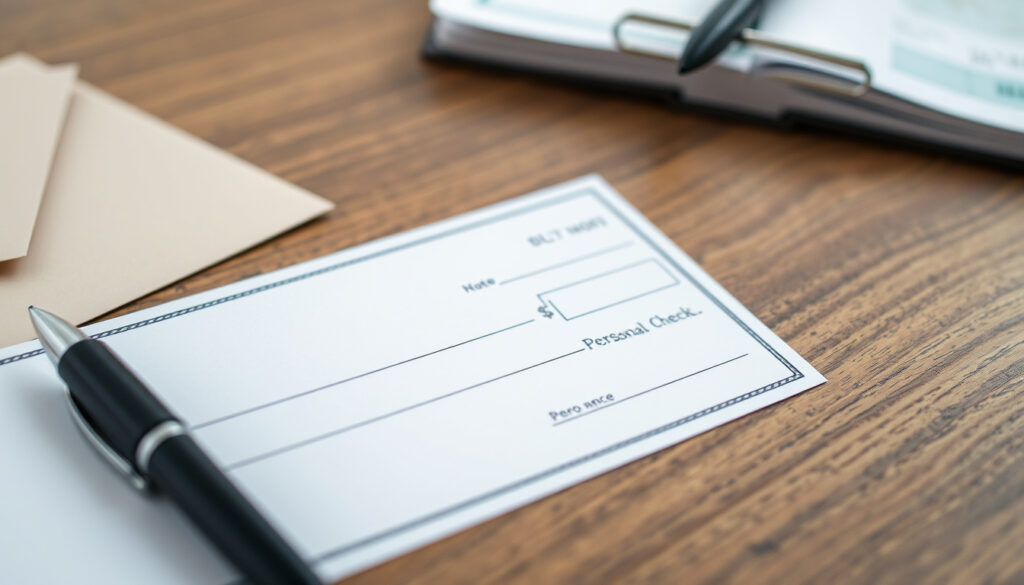
How to Write a Check: Step-by-Step Guide with Examples
You’ve probably written a check before, but maybe not since high school—and the rules have stayed surprisingly consistent. This guide walks through every field, from the date line to the signature, with exact examples for cents, thousands, and even Irish cheques.
Checks processed annually in the U.S.: approximately 14.5 billion (Federal Reserve) ·
Average check amount written by consumers: about $1,200 (Fidelity) ·
Percentage of U.S. adults who used a check in the past year: about 20% (Pew Research) ·
Maximum safe check amount before bank hold: $5,525 on the first $5,525 deposited (Regulation CC)
Quick snapshot
- Check amount fields must match; written words take precedence (UCC 3-114) (UCC 3-114 via UCD Societies (university resource))
- Post-dated checks are legally payable on demand (UCC 3-112) (Regions Bank (banking institution))
- Fraction notation for cents is standard and required on the written line (Chase (major U.S. bank))
- Whether banks will honor a post-dated check before the date varies by policy (Regions Bank)
- The exact consequences of writing the name too far from the left margin may differ by bank (UCD Societies)
- Checks are valid for up to 6 months in the U.S. (Fidelity (financial services firm))
- Irish cheques clear in 2-4 business days (Irish Payment Services (national payment authority))
- Consider digital payment alternatives for speed and security (PNC Insights (financial education resource))
- Voided checks can be used for direct deposit setup (Huntington Bank (financial institution))
Five key facts about checks, one pattern: the written amount always wins if there’s a conflict.
| Fact | Detail |
|---|---|
| First modern check use | 1717, Bank of England |
| U.S. check volume | 14.5 billion/year |
| Average check amount | $1,200 |
| Written amount rule | UCC 3-114: written words override numeric |
| Check validity (U.S.) | Up to 6 months (most banks) |
| Irish cheque clearing | 2-4 business days |
What is the proper way to write a check?
The standard six-step process, confirmed by every major bank, follows a fixed order. Here’s how to fill each field correctly.
- Date the check
- Write the payee name
- Enter the numeric amount
- Write the amount in words
- Fill in the memo line (optional)
- Sign the check
Step 1: Date the check in the upper right corner
Write today’s date in the format you prefer — Spero Financial (credit union guidance) says short form (e.g., 4/15/2025) or long form (April 15, 2025) both work. Use black or blue permanent ink; never pencil. Post-dated checks are legal but Regions Bank (banking institution) warns that banks are not required to delay processing them.
Step 2: Write the payee name on the “Pay to the Order of” line
Use the full legal name of the person or business. UCD Societies (Irish university resource) advises writing the name as close to the start of the line as possible to prevent alteration. Leave no blank space before the name.
Step 3: Enter the numeric amount in the box
Place the dollar amount in the small box on the right. Use a decimal point and two digits for cents — $50.00, not $50. Fidelity Investments (financial services firm) emphasizes that even for round amounts, include “.00” to prevent tampering.
Step 4: Write the amount in words on the dollar line
This is the long line below the payee name. Write the dollar amount in words, then “and” followed by cents as a fraction over 100. For $150.75: “One hundred fifty and 75/100.” Chase (major U.S. bank) confirms that the written amount controls over the numeric box under UCC 3-114. Webster First (credit union) recommends drawing a line from the end of the written amount to the end of the line to prevent additions.
Step 5: Fill in the memo line (optional)
The memo line at the bottom left is for your reference — account number, invoice, or “Birthday gift.” Spero Financial (credit union guidance) notes it’s the only field that is not mandatory.
Step 6: Sign the check on the bottom right signature line
Your signature authorizes the payment. Regions Bank (banking institution) warns that unsigned checks are not valid. Never sign a blank check — it can be legally filled by the bearer.
The signature is your final lock. Without it, the check is just a piece of paper. With it, you’ve authorized a transfer of funds — so make sure every field is correct before signing.
The implication: Each step protects against a specific fraud vector, and skipping any one undermines the whole system.
How do you write a check with cents?
Handling cents correctly is the most common point of confusion. The rule is simple: use a fraction over 100 in the written line.
Writing cents in the numeric box
Use a decimal point followed by two digits. For $105.50, write “105.50” in the box. Fidelity (financial services firm) says whole-dollar checks should still show “.00” to prevent someone from adding cents later.
Writing cents in words
On the written amount line, use the fraction format: “and 50/100.” PNC Insights (financial education resource) confirms that cents must be expressed as a fraction. Chase (major U.S. bank) adds that you can also write “and 50/100” or “and fifty cents” — both are accepted, but the fraction format is preferred for clarity.
Example: $150.75
Numeric box: $150.75. Written line: “One hundred fifty and 75/100.” Draw a line after “75/100” to fill the space. Webster First (credit union) calls this a critical anti-fraud step.
How do you write $1500 on a check?
Large amounts in the thousands follow the same pattern, but there are a few formatting details to watch.
Numeric amount box
Write “$1500.00” without commas in the box. Commas are optional in the numeric box — Fidelity (financial services firm) shows “$1,500.00” as acceptable, but consistency is key.
Written amount line
Write “One thousand five hundred and 00/100.” Do not use “and” between thousands and hundreds — “One thousand five hundred” is correct. Associated Bank (regional bank) advises writing the full amount in words, including cents.
Example: $5,000
Numeric box: $5000.00. Written line: “Five thousand and 00/100.” Ensure the cents fraction is present even for round amounts.
If you write “Five thousand dollars” without the cents fraction, the bank may still process it, but the missing fraction creates an opportunity for alteration. Always include “and 00/100.”
The pattern: Every omitted digit or fraction leaves a target for fraud, so completeness is non-negotiable.
What are the three rules for check writing?
Three non-negotiable rules protect both you and the recipient. They’re grounded in banking law and common sense.
Rule 1: Use permanent ink and write legibly
Black or blue ink only. Pencil or erasable ink makes the check vulnerable to fraud. Spero Financial (credit union guidance) explicitly recommends permanent ink.
Rule 2: Match the numeric and written amounts exactly
If there’s a discrepancy, the written words control under UCC Section 3-114 (Uniform Commercial Code). This is a legal safeguard, but it’s better to avoid confusion entirely.
Rule 3: Never sign a blank check
A signed blank check is legally equivalent to giving someone a signed blank contract. FDIC (federal deposit insurance regulator) warns that blank checks can be filled for any amount by the bearer.
These three rules are the difference between a check that clears safely and one that becomes a liability. The UCC reference is your legal backstop, but prevention beats cure.
What this means: A single lapse—erasable ink, mismatched amounts, or a blank signature—can turn a routine payment into a financial headache.
How do you write a cheque in Ireland?
Irish cheques follow a very similar structure to U.S. checks, but with important differences in terminology and security features.
Terminology and layout
Irish cheques use “Pay” instead of “Pay to the Order of.” The date format is day/month/year (e.g., 15/04/2025). UCD Societies (Irish university resource) provides a PDF guide showing the exact layout.
Crossed cheques
Two parallel lines across the cheque indicate a “crossing,” meaning the cheque can only be deposited into a bank account, not cashed over the counter. This is a standard security feature in Ireland.
Amount in words
Write the amount in words and end with “Euro.” For example, “One hundred fifty Euro and 75/100.” Irish Payment Services (national payment authority) states that domestic cheques clear in 2–4 business days.
Example: Irish cheque for €250.30
Pay line: “Pay John Murphy” (write name close to “Pay”). Numeric box: €250.30. Written line: “Two hundred fifty Euro and 30/100.” Crossing: two parallel lines on the top left.
Crossing adds security but removes the option to cash the cheque. If you need cash, you’ll need to endorse the cheque at the bank branch — or request an uncrossed cheque from the issuer.
The takeaway: Irish cheque writers gain an extra layer of protection that U.S. users lack, but at the cost of immediate liquidity.
What’s confirmed and what’s unclear?
Confirmed facts
- Check amount fields must match; written words take precedence (UCC 3-114).
- Post-dated checks are legally payable on demand (UCC 3-112).
- Fraction notation for cents is standard and required on the written line.
- Irish cheques use crossing for security and require “Euro” in the written amount.
What’s unclear
- Whether banks will honor a post-dated check before the date varies by policy.
- The exact consequences of writing the name too far from the left margin may differ by bank.
“Start by writing the date in the upper right corner. Then write the payee’s name on the ‘Pay to the Order of’ line.”
— Huntington Bank (financial institution guide)
“Always include .00 for even amounts and draw a line after the cents fraction.”
— Fidelity Learning Center (financial education)
“Write the dollar amount in words and cents as a fraction of 100.”
— Chase Bank (national bank guide)
“Draw a line after the written amount to prevent anyone adding additional numbers.”
— Reddit r/coolguides (user tip, confirms consensus)
For the hundreds of millions of checks still written each year, the margin between a properly filled check and a fraudulent one is a matter of simple habits. For U.S. consumers, the implication is clear: always use permanent ink, match the amounts, and never sign a blank check. For Irish cheque writers, crossing and the “Euro” suffix are your best defenses. The choice is between a check that clears without incident and one that leaves you chasing a correction.
Related reading: **Rocket Mortgage Sign In: Step-by-Step Login & Payment Guide**
stories.wf.com, wafdbank.com, youtube.com, texasbaptistcollege.com, linkedin.com, bpi.com.ph
If you need extra help with the amount line, this guide on cents and large amounts provides clear instructions for writing cents and large figures.
Frequently asked questions
Can I post-date a check?
Yes, you can post-date a check, but under UCC 3-112, banks are legally allowed to process it before the date unless you issue a stop-payment order. Regions Bank (banking institution) advises that post-dating is not a guarantee of delay.
What happens if I write the wrong amount?
If the numeric and written amounts differ, the written words prevail under UCC 3-114. The bank will likely contact you, but it’s best to void the check and start over.
Is it safe to mail a check?
Mailing a check carries risk of theft or fraud. Use a secure envelope, avoid writing “check” on the outside, and consider using a crossed cheque (in Ireland) or a cashier’s check for larger amounts.
How long is a check valid?
In the U.S., most banks will honor a check for up to six months from the date written. After that, it’s considered “stale” and may be rejected. Fidelity (financial services firm) confirms this general rule.
What do I do if a check is lost?
Contact your bank immediately to issue a stop-payment order. You’ll need the check number, amount, and payee name. There is usually a fee. Regions Bank (banking institution) recommends acting quickly.
Can I write a check to myself?
Yes. Write your own name as the payee, sign the back to endorse it, and deposit or cash it at your bank. This is a common way to transfer funds between accounts.
Do I need to fill in the memo line?
No. The memo line is optional and for your reference only. Spero Financial (credit union guidance) notes it’s the only field that is not mandatory.
More related posts
 Bird of Paradise Plant Care: Indoor Guide and Tips
 Full Mouth Dental Implants – Cost, Procedure, Recovery Guide
 Pope John Paul I – 33-Day Reign, Death Mystery and Beatification
 Where to Watch Red Sox vs Yankees Live: TV & Stream
 The Times of Israel: News from Israel & Jewish World
 Hand Foot and Mouth Symptoms: Early Signs & Stages
 Inside Out 2 New Emotions: Complete Guide
 Borussia Dortmund vs Barcelona Stats: Head-to-Head Record