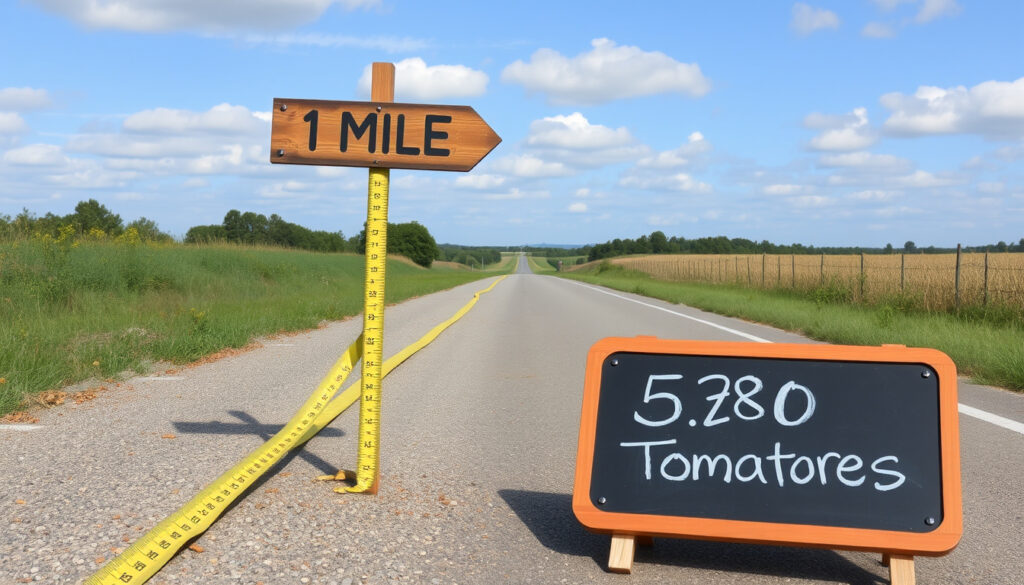
How Many Feet Are in a Mile? The Exact Answer & Easy Mnemonics
The humble mile contains exactly 5,280 feet – a number rooted in Roman marching and Elizabethan law. This guide provides the exact conversion, memory tricks, and comparisons to kilometers, steps, and more.
Feet in 1 mile: 5,280 ·
Yards in 1 mile: 1,760 ·
Inches in 1 mile: 63,360 ·
Meters in 1 mile: 1,609.344 ·
Common steps per mile (average): 2,000–2,500
Quick snapshot
- 1 mile = 5,280 feet (Cornell Legal Information Institute (U.S. legal code database))
- 1 mile = 1,760 yards (Wikipedia (encyclopedic reference))
- 1 mile = 63,360 inches (Wikipedia (encyclopedic reference)) (Cornell Legal Information Institute (U.S. legal code database))
- Exact step count per mile varies widely by stride length, height, and walking speed.
- Origins of the term “furlong” are partially conjectural.
- c. 100 BC: Roman mille passus ≈ 5,000 ft (Wikipedia (historical reference))
- 1593: English statute mile defined as 5,280 ft (Britannica (encyclopedia))
- 1959: International yard agreement fixes mile at 1,609.344 m (German Wikipedia (metric standards))
- Understanding mile conversions helps in fitness tracking, land measurement, and navigation.
- Modern apps and devices rely on the 5,280-foot standard for distance reporting.
The following table anchors the mile in the English measurement system.
| Measurement | Value |
|---|---|
| Standard feet in a mile | 5,280 |
| Standard yards in a mile | 1,760 |
| Standard inches in a mile | 63,360 |
| Meters in a mile (exact) | 1,609.344 |
| Furlongs in a mile | 8 |
| Year mile standardized at 5,280 ft (England) | 1593 |
How many feet are in a mile?
What is the exact number of feet per mile?
The international mile — the unit used in the United States and the United Kingdom — is defined as 5,280 feet. This is the official legal definition in the U.S., as codified in Title 15 of the U.S. Code (the legal framework for standards). The same standard applies in the UK and most English-speaking countries.
How do you convert miles to feet?
Conversion is straightforward: multiply the number of miles by 5,280. For example, 2 miles = 2 × 5,280 = 10,560 feet. To convert feet back to miles, divide by 5,280. This relationship is exact and never changes.
- Quarter mile: 0.25 × 5,280 = 1,320 feet
- Half mile: 0.5 × 5,280 = 2,640 feet
- Marathon (26.2 miles): 26.2 × 5,280 = 138,336 feet
The pattern: the mile is a linear unit that aligns with the older English system of furlongs and yards. Britannica (the authoritative encyclopedia) notes that the statute mile is exactly 8 furlongs, each furlong being 660 feet — which multiplies to 5,280.
Is 1 mile 2000 feet?
Common misconceptions about mile length
No. A mile is 5,280 feet, not 2,000. The confusion often arises from step counting. The average person’s stride length means roughly 2,000 steps covers about a mile, but that’s a rough estimate, not a definition. The visual below shows the gap:
- 1 mile (actual) = 5,280 feet
- 1 mile (step estimate) ≈ 2,000 steps × ~2.5 ft per step = 5,000 ft (close but not exact)
The relationship between steps and miles
Step length varies by height, leg length, and walking speed. A person 5’5″ tall might have a stride of 2.1 feet, requiring about 2,514 steps per mile. A taller person at 6’0″ might stride 2.5 feet, needing about 2,112 steps. So 2,000 steps is a ballpark, not a conversion.
Step counters on phones and watches use the 5,280-foot standard as the baseline, but individual error can be 10–20% if stride length isn’t calibrated. For accurate distance, input your actual stride length into the app.
The implication: step count is a personal metric, not a definition of the mile. Understanding that distinction prevents over- or underestimation of distance.
How to remember 5280 feet in a mile easily?
Mnemonic devices for 5,280
The most popular mnemonic is “Five Tomatoes” — say it quickly: “five-to-mah-toes” sounds like “five-two-eight-oh”. Multiple sources, including Math.net (educational math resource) and EngConvert (conversion guide), use this trick. Another memory aid from Mammoth Memory (memory techniques) suggests visualizing five tomatoes lined up.
Other conversion reminders
If mnemonics aren’t your style, use the math: 1 mile = 8 furlongs × 220 yards per furlong × 3 feet per yard = 5,280 feet. That’s a chain of three simple numbers: 8, 220, 3. Remembering “8-220-3” gives you the product. Also, 1 mile = 1,760 yards; multiply by 3 to get feet.
The pattern: the mile is deeply tied to the furlong, a unit that originally meant “furrow-long” in medieval English farming. Understanding that connection helps the number stick.
Why is a mile 5280 feet?
Historical origin of the mile
The story begins with the Roman mille passus — “a thousand paces.” A Roman pace was two steps, so 1,000 paces was about 5,000 Roman feet. As the Roman Empire expanded, this measurement spread across Europe. Wikipedia (historical reference) notes that the Roman mile was roughly 5,000 feet, close to but not exactly our modern mile.
From Roman mille passus to Elizabethan statute
In medieval England, the mile varied locally. The turning point came in 1593 under Queen Elizabeth I, when Parliament passed a statute standardizing the mile as 8 furlongs. Britannica (the historical encyclopedia) explains that the statute mile was defined as 8 furlongs, each furlong being 660 feet — yielding 5,280 feet exactly. The choice of 8 furlongs was practical: the furlong was a common agricultural unit (the length of a plowed furrow), and multiplying by 8 gave a convenient distance for land measurement. This 1593 definition remains the basis of the modern mile.
The 1593 standardization solved the problem of local variations — but it locked in a number that feels arbitrary today. However, because it was tied to the furlong (which itself was tied to the acre), it made land surveying consistent for centuries.
The implication: the mile’s odd 5,280 feet is a direct inheritance from Roman paces and English agriculture, not a random choice.
How many steps are in a mile?
Average step length and variations
Step length is the distance from the heel of one foot to the heel of the other when walking. For an average adult, step length ranges from 2.1 to 2.5 feet. Shorter individuals (e.g., 5’2″) may have a step length of 2.0 feet, while taller people (6’0″+) may reach 2.7 feet. Using 5,280 feet per mile:
- 2.0 ft step: 5,280 ÷ 2.0 = 2,640 steps
- 2.3 ft step: 5,280 ÷ 2.3 ≈ 2,296 steps
- 2.5 ft step: 5,280 ÷ 2.5 = 2,112 steps
So the common claim “2,000 steps per mile” is a rough average. For a more precise count, measure your own step length by walking a known distance (e.g., 20 feet) and dividing by the number of steps.
How many miles is 10,000 steps?
10,000 steps is a popular fitness goal. At an average step length of 2.3 feet, 10,000 steps equals about 23,000 feet, or 23,000 ÷ 5,280 ≈ 4.35 miles. Taller individuals with longer strides may cover 5 miles or more; shorter individuals may cover a bit less. The 10,000-step target doesn’t have a strong scientific basis — it originated as a marketing slogan in Japan in the 1960s — but it remains a useful daily benchmark.
How does 1 mile compare to 1 kilometer?
Feet in a mile vs. meters in a kilometer
1 mile = 5,280 feet. 1 kilometer = 3,280.84 feet (since 1 km = 1,000 meters, and 1 meter = 3.28084 feet). So a mile is about 1.609 times longer than a kilometer. In metric terms, 1 mile = 1.609344 kilometers, and 1 kilometer = 0.621371 miles.
Practical conversion tips
For runners, a common conversion: 5 kilometers ≈ 3.1 miles; 10 kilometers ≈ 6.2 miles. To quickly convert miles to kilometers in your head, multiply by 1.6 (or 1.609 for more precision). To go from kilometers to miles, divide by 1.6. For example, a 10 km race is about 10 ÷ 1.6 = 6.25 miles.
The pattern: the mile is approximately 1.6× longer than the kilometer. This difference matters for race pacing, fuel consumption, and travel planning.
One more conversion: the nautical mile — used for air and sea navigation — is different. It is defined as exactly 1,852 meters (about 6,076 feet), based on one minute of latitude. So if you’re reading a nautical chart, don’t use 5,280.
For anyone using a GPS device or fitness tracker, knowing the exact foot conversion helps you calibrate distance. If your app thinks a mile is 2,000 steps but your stride is longer, you’ll overestimate distance. The 5,280-foot standard is the bedrock.
The catch: the mile and kilometer serve different systems; being comfortable with both avoids costly errors in travel and sport.
Conversion table: Mile to other units
Six common units, one pattern: the mile is a composite of older English measurements that still shape how we measure land and travel.
| Unit | Per 1 mile |
|---|---|
| Feet | 5,280 |
| Yards | 1,760 |
| Inches | 63,360 |
| Meters | 1,609.344 |
| Kilometers | 1.609344 |
| Steps (average) | 2,000–2,500 |
Step-by-step guide to memorizing the mile
Whether you’re a student, a runner, or just curious, these three steps will lock the number 5,280 into your memory.
- Learn the mnemonic: Say “Five Tomatoes” out loud five times. The rhythm mimics the digits 5-2-8-0.
- Build the chain: Remember 8 furlongs × 220 yards per furlong × 3 feet per yard = 5,280. Write it down once.
- Apply it daily: Whenever you see a mile marker on a road or a treadmill, mentally convert: 5,280 feet. After a week, it becomes automatic.
The pattern: repetition combined with a story (the Roman origin, the Elizabethan statute) makes the number stick far better than rote drilling.
Timeline: How the mile evolved
Three key moments shaped the mile we use today:
- c. 100 BC — Roman mille passus (1,000 paces) established, roughly 5,000 feet. (Wikipedia (historical reference))
- 1593 — English Parliament standardized the mile to 8 furlongs = 5,280 feet. (Britannica (historical encyclopedia))
- 1959 — International yard and pound agreement defined 1 yard = 0.9144 m, fixing the mile at 1,609.344 m. (German Wikipedia (metric standards))
The implication: The mile didn’t change in 1959 — it was just defined more precisely. The Roman seed planted over 2,000 years ago still determines how far you walk today.
What’s confirmed and what’s still unclear
Confirmed facts
- 1 mile = 5,280 feet (international mile).
- 1 mile = 1,609.344 meters.
- Statute mile defined in 1593.
What’s unclear
- Exact step count per mile varies widely by stride length, height, and walking speed.
- Origins of the term “furlong” are partially conjectural.
- Historical local miles (Irish, Scottish) had different lengths, but their exact usage records are incomplete.
“A mile contains eight furlongs, each furlong forty poles, and each pole sixteen and a half feet.”
— English Statute of 1593, as cited in Wikipedia (historical legal reference)
“The mile became 5,280 feet during the reign of Queen Elizabeth I under a statute of 1593.”
— Britannica (encyclopedic reference)
For fitness enthusiasts, the 5,280-foot mile is the standard your treadmill, running app, and GPS rely on. If you’re training for a 5K, you’re covering 3.1 miles — that’s 16,368 feet. For runners who track elevation gain, knowing that a mile contains 5,280 feet vertically as well as horizontally is crucial for gradient calculations. The choice is clear: embrace the odd precision of 5,280, or switch to the metric system. But as long as you’re on a road in the U.S. or UK, the mile — and its 5,280 feet — isn’t going anywhere.
algarvehistoryassociation.com, encyclopedia.com, academicjobs.com, oreateai.com, facebook.com
For a comprehensive overview, this detailed conversion guide explains the 5,280 feet in a mile with easy mnemonics.
Frequently asked questions
Is 1 mile exactly 5,280 feet?
Yes, the international statute mile is defined as exactly 5,280 feet, as codified in U.S. law and international agreement.
How many feet are in a half mile?
Half a mile equals 2,640 feet (5,280 ÷ 2).
What is the difference between a statute mile and a nautical mile?
A statute mile is 5,280 feet (1,609.344 m). A nautical mile is 6,076 feet (1,852 m), based on one minute of latitude.
How many feet are in a mile for a person who is 5’5″?
The mile is still 5,280 feet regardless of your height. The number of steps you take to cover it varies, but the distance is fixed.
How long does it take to walk a mile at an average pace?
At a moderate walking pace of 3 mph, it takes about 20 minutes to walk a mile. At a brisk pace of 4 mph, about 15 minutes.
Can I use feet to measure my hiking or running distance accurately?
Yes, but it’s impractical. Hikers and runners typically use miles or kilometers. However, GPS devices calculate distance using the 5,280-foot standard, so your mileage is accurate.
Related reading: 6 Inches to cm – Exact Conversion & Common Mistakes · How to Find the Area of a Circle: Formula & Examples
More related posts
 How to Fix ‘Syncing with iCloud Paused’ on iPhone and Mac
 Lady Gaga Abracadabra Lyrics – Meaning Release Video Analysis
 Crisis on Infinite Earths: Watch Order & Comics Guide
 Mormon Church Near Me: Find Your Local LDS Ward in Ireland
 Venom: Let There Be Carnage – Reviews, Streaming Guide
 Erikson’s Stages of Development – 8 Stages Explained with Ages and Examples
 Ouai Leave-In Conditioner vs Olaplex: How to Use & Review