What Is Cloud Seeding? How It Works, Effects, and Risks
Few weather topics stir up as much curiosity and controversy as cloud seeding. It’s a technique that has been around since the 1940s, yet most people can’t say for sure how it works or whether it really makes a difference. This guide walks through the science, the real-world evidence, and the unresolved questions that still surround the practice.
Number of countries using cloud seeding: More than 50 ·
Year first cloud seeding experiment conducted: 1946 ·
Most common seeding agent: Silver iodide ·
Estimated precipitation increase: 5–15% ·
Country with the largest cloud seeding program: China
Quick snapshot
- Weather modification technique to increase precipitation (U.S. Government Accountability Office (federal oversight body))
- Uses particles like silver iodide as ice nuclei (U.S. Government Accountability Office (federal oversight body))
- First developed in 1946 (U.S. Government Accountability Office (federal oversight body))
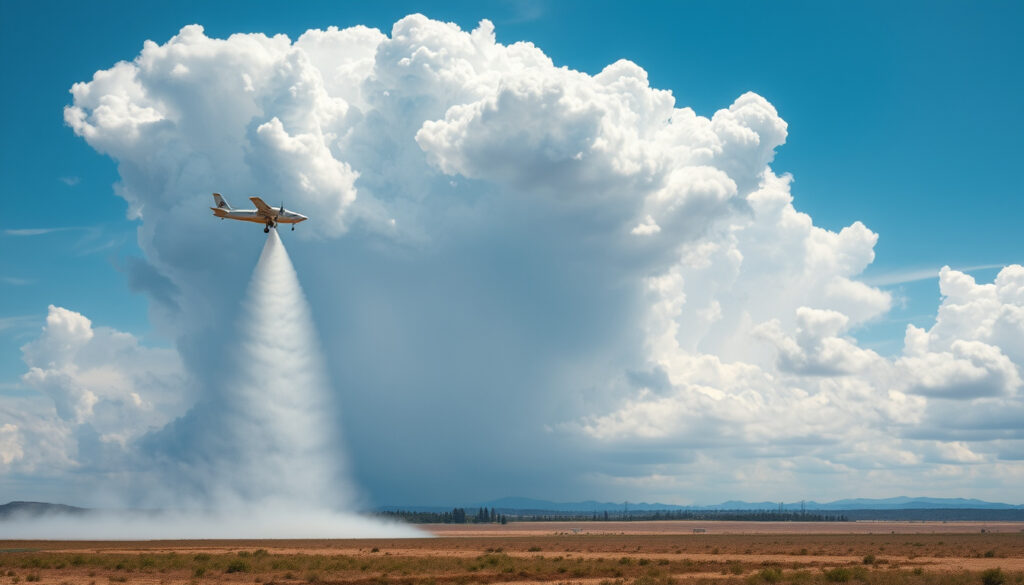
- Particles introduced into clouds via aircraft or ground generators (The Japan Times (leading English-language Asian news))
- Encourages condensation or ice formation (The Japan Times (leading English-language Asian news))
- Rain or snow falls from treated clouds (The Japan Times (leading English-language Asian news))
- Over 50 countries, including China, USA, UAE, India (U.S. Government Accountability Office (federal oversight body))
- China has the largest program (U.S. Government Accountability Office (federal oversight body))
- Used in regions with water scarcity (U.S. Government Accountability Office (federal oversight body))
- Environmental impact of silver iodide (The Japan Times (leading English-language Asian news))
- Health risks and lack of regulation (The Japan Times (leading English-language Asian news))
- Alteration of natural weather patterns (The Japan Times (leading English-language Asian news))
| Label | Value |
|---|---|
| Definition | Cloud seeding is a weather modification technique that introduces substances into clouds to alter precipitation. |
| Common agent | Silver iodide |
| First use | 1946 by Vincent Schaefer |
| Global adoption | More than 50 countries |
| Effectiveness | Estimated 5–15% increase in precipitation |
The pattern: each data point reinforces how widely deployed cloud seeding is, yet how little is known about its downstream effects.
What is cloud seeding and how does it work?
What is cloud seeding?
- Cloud seeding is a weather modification technique that introduces particles into existing clouds to encourage precipitation (U.S. Government Accountability Office (federal oversight body)).
- It is not about creating clouds from nothing; it works on clouds that already exist (U.S. Government Accountability Office (federal oversight body)).
The idea is to give nature a nudge. When the right atmospheric conditions are already present – a deck of supercooled clouds, for instance – seeding can trigger precipitation that would not have fallen otherwise.
How does cloud seeding work?
- Particles are dispersed into supercooled water clouds, where droplets freeze around the particles and then grow into precipitation (NSW Environment Protection Authority (Australian state regulator)).
- Cloud seeding can be conducted by aircraft or by ground-based generators (The Japan Times (leading English-language Asian news)).
Think of it like adding a tiny seed to a supersaturated solution – the particle becomes the nucleus around which ice or water forms. In the Snowy Mountains of Australia, an independent evaluation found that winter cloud seeding increased snowfall by an annual average of 14% (NSW Environment Protection Authority (Australian state regulator)).
Cloud seeding is a targeted intervention, not a magic wand. Its effectiveness hinges entirely on the presence of suitable clouds – a fact that limits its usefulness in the very drought conditions that often prompt calls for it (CNBC (global business news network)).
What materials are used in cloud seeding?
- Silver iodide is the most widely used agent because it can act as an ice nucleus in cold clouds (NSW Environment Protection Authority (Australian state regulator)).
- Salt or other particles can also be used, depending on the cloud type and target outcome (The Japan Times (leading English-language Asian news)).
The choice of material matters because it determines the temperature range in which nucleation can occur. Silver iodide works well for cold clouds; salt is more effective for warm clouds, which is why the UAE often uses salt-based hygroscopic flares.
What are the negative effects of cloud seeding?
Is cloud seeding bad for the environment?
- Silver iodide can accumulate in soil and water, potentially affecting ecosystems (The Japan Times (leading English-language Asian news)).
- However, the NSW Snowy Mountains program’s compliance reporting states that silver iodide is practically insoluble in water and does not become biologically available in the environment (NSW Environment Protection Authority (Australian state regulator)).
The environmental safety question is a classic case of “it depends.” The U.S. GAO reported that existing research suggests silver iodide does not pose an environmental or health concern at current levels (U.S. Government Accountability Office (federal oversight body)). But the same report notes that the evidence base on effectiveness and environmental impacts remains limited to a handful of recent studies.
Does cloud seeding cause pollution?
- Cloud seeding can be linked to unintended local flooding where precipitation was intensified beyond expectations (The Japan Times (leading English-language Asian news)).
- Some analyses describe cloud seeding as potentially redistributing precipitation rather than creating new water, raising concerns that one area may gain rain at another’s expense (The Bulletin of the Atomic Scientists (security-focused journal)).
The trade-off: boosting rain in one place may rob the next valley of moisture. This is a real, unresolved physical question, not a conspiracy theory.
What are the health risks of cloud seeding?
- No peer-reviewed studies have linked cloud seeding to adverse health outcomes in humans, but monitoring remains sparse (U.S. Government Accountability Office (federal oversight body)).
Because silver iodide is used in tiny quantities (parts per billion in rainwater), the health risk is widely considered negligible. Yet the absence of evidence is not evidence of absence – and populations in countries with heavy seeding programs have not been systematically studied.
The same GAO report that calls silver iodide safe also warns that the evidence base for the entire practice is thin. For a technique deployed in more than 50 countries, that is a remarkable gap.
Which countries are using cloud seeding?
Which country does the most cloud seeding?
- China operates the largest cloud seeding program, covering millions of square kilometers (U.S. Government Accountability Office (federal oversight body)).
- The program was notably expanded for the 2008 Olympic Games and continues to be used for drought relief and air quality control.
China’s investment dwarfs all others. The country reportedly spends over $100 million per year on weather modification, including cloud seeding, hail suppression, and fog dispersal.
Is there cloud seeding in Europe?
- Several European countries have experimented with cloud seeding, including France, Spain, and Greece, but programs are smaller and often seasonal (The Japan Times (leading English-language Asian news)).
- Switzerland ran a long-term winter cloud seeding project in the Alps to increase snowfall for ski resorts.
Europe’s approach is cautious. The World Meteorological Organization has issued guidelines for cloud seeding operations, but no EU-wide regulation exists. Each country decides its own rules.
What countries use cloud seeding?
- More than 50 countries have active cloud seeding programs, including the United States, United Arab Emirates, India, Australia, China, Saudi Arabia, and South Africa (U.S. Government Accountability Office (federal oversight body)).
- The UAE has been a particularly high-profile adopter, using drones and nanotechnology to enhance rainfall in the arid desert.
The geographic spread is wide, but the intensity varies hugely. China and the UAE are the most aggressive; many others run small, research-oriented projects.
Why do people worry about using cloud seeding?
Is cloud seeding safe?
- Current regulatory assessments from the U.S. GAO and the NSW EPA consider cloud seeding safe at current levels of use (U.S. Government Accountability Office (federal oversight body)).
- Yet the World Meteorological Organization expert assessment published in 2019 found precipitation increases ranging from essentially zero to around 20% – a massive uncertainty that undermines confidence in both safety and effectiveness (Phys.org (science news outlet)).
The real worry is not that cloud seeding is known to be dangerous, but that it is deployed at scale with very little long-term monitoring.
Is cloud seeding illegal?
- Cloud seeding is legal in many countries but subject to varying regulations. Some jurisdictions require permits, while others have no specific laws at all (U.S. Government Accountability Office (federal oversight body)).
- Australia’s Snowy Mountains program operates under a specific act (Snowy Mountains Cloud Seeding Act 2004) that mandates annual compliance reporting (NSW Environment Protection Authority (Australian state regulator)).
The legal patchwork means that what is permitted in one country may be banned in another. No global consensus exists on the safety and long-term effects of cloud seeding.
What are the ethical concerns?
- Potential weaponization of weather modification – the UN Convention on the Prohibition of Military or Any Other Hostile Use of Environmental Modification Techniques (ENMOD) bans weather warfare, but allegations persist.
- Lack of regulation and transparency in many countries, making it difficult for the public to know when and where seeding is happening.
The ethical debate is not just about silver iodide. It is about who gets to decide when, where, and how much to intervene in the weather – and who bears the risk.
The next few years will be critical. As droughts intensify and water scarcity grows, pressure to scale up cloud seeding will increase. Without a corresponding investment in independent monitoring and regulation, the world could be flying blind.
How to tell if cloud seeding is happening?
What does cloud seeding look like?
- Cloud seeding often involves aircraft or ground generators releasing particles into clouds (The Japan Times (leading English-language Asian news)).
- Seeded clouds may appear different, but visual cues are not always reliable. Aircraft may be seen flying under or into clouds, sometimes leaving a faint trail of particles.
You cannot reliably tell if a cloud is being seeded just by looking at it. The most common visible sign is an aircraft flying in an unusual pattern – making repeated passes through the same cloud band.
How do I know if they are cloud seeding?
- Radar and atmospheric measurements are used to detect and monitor cloud seeding activities (U.S. Government Accountability Office (federal oversight body)).
- Some programs publish seeding schedules; others do not. In the United States, cloud seeding operations are typically permitted by state or local authorities and may be disclosed in public records.
For the average person, the best way to know is to check local news or government announcements. In regions with active programs, the information is usually public – but not always easy to find.
Can you see cloud seeding from the ground?
- Ground-based generators are stationary and look like large fans or cannons. They are often placed in mountainous areas.
- Aircraft-based seeding is harder to spot from the ground unless you are directly under the flight path.
If you see a small plane repeatedly flying in a grid pattern over a cloud bank, it might be seeding. But without a radar confirmation, you are guessing.
Timeline: Cloud seeding through the decades
- 1946 – First cloud seeding experiment by Vincent Schaefer, using dry ice.
- 1950s–1960s – Expansion of cloud seeding programs in the United States and other countries.
- 2000s – China begins large-scale cloud seeding for Olympic Games and drought relief.
- 2010s – UAE launches cloud seeding operations using drones and nanotechnology.
- 2020s – Increased debate over environmental impacts and regulatory frameworks.
The pattern is clear: as water stress grows, so does interest in cloud seeding. But the timeline also shows that the science has not kept pace with the deployment.
Confirmed facts vs. what remains unclear
Confirmed facts
- Cloud seeding can increase precipitation by 5–15% under certain conditions (NSW Environment Protection Authority (Australian state regulator)).
- Silver iodide is the most widely used seeding agent.
- Over 50 countries have active cloud seeding programs (U.S. Government Accountability Office (federal oversight body)).
What’s unclear
- Long-term environmental effects of silver iodide accumulation.
- Consistency of cloud seeding effectiveness across different climates (Phys.org (science news outlet)).
- Potential health risks for populations in seeded areas.
Quotes from experts and pioneers
“I dropped a little dry ice into a cloud and it started to snow.”
Vincent Schaefer, 1946 (U.S. Government Accountability Office (federal oversight body))
“Cloud seeding is not a silver bullet for water scarcity, but it can be part of a broader portfolio of water management tools.”
NOAA statement on weather modification (U.S. Government Accountability Office (federal oversight body))
“The evidence base on effectiveness remains limited to a handful of recent studies.”
U.S. Government Accountability Office, 2024 report (U.S. Government Accountability Office (federal oversight body))
Cloud seeding has its advocates and its skeptics. The science is real, but the proof is thin. For a water manager in California, the choice is clear: invest in a technology that may deliver a 10% boost in snowfall, or accept the status quo. For a community downstream, the risk is that the rain that falls on someone else’s fields is the rain that does not fall on theirs.
nrc.nsw.gov.au, thebulletin.org, irjhis.com, idwr.idaho.gov, snowyhydro.com.au, en.wikipedia.org, pcwaa-az.org
Frequently asked questions
Is cloud seeding effective?
Yes, under the right conditions. Studies show a 5–15% increase in precipitation, but effectiveness varies widely by region and weather pattern (U.S. Government Accountability Office (federal oversight body)).
How long does it take for rain to fall after cloud seeding?
It depends on the cloud type and atmospheric conditions. Precipitation can begin within minutes to a few hours after seeding.
Can cloud seeding cause flooding?
There have been reports of unintended local flooding where seeding intensified precipitation beyond expectations (The Japan Times (leading English-language Asian news)).
Does cloud seeding work in all climates?
No. It works best with supercooled clouds (cold climates) or warm clouds with hygroscopic agents. Arid climates often lack the necessary cloud cover.
What is the history of cloud seeding?
The first experiment was in 1946 by Vincent Schaefer. Since then, it has been used in over 50 countries, with major expansions in China and the UAE in the 2000s and 2010s.
Is cloud seeding a form of geoengineering?
It is considered a form of weather modification, which is a subset of geoengineering. However, it is distinct from solar radiation management, which aims to block sunlight.
How much does cloud seeding cost?
Costs vary widely. A small program can run a few hundred thousand dollars per year; China’s national program reportedly exceeds $100 million annually.
More related posts
 Borussia Dortmund vs Barcelona Stats: Head-to-Head Record
 Scotts Weed and Feed: When to Apply, Watering Tips, and FAQ
 Polar Vortex Collapse Forecast – 2025-2026 Winter Risks
 How to Lower A1C: Proven Strategies from Medical Experts
 30 Days From Now: Calculator, Steps & Leap Year Guide
 Jelly Roll’s ‘Halfway to Hell’: Meaning, Release, and Past
 Delete Stickers on iPhone: iOS 17-26 Guide
 Dental Assistant Jobs Near Me in Ireland: Hiring 2026